
How to find the area of a trapezoid
A trapezoid’s slanted sides can make its area look tricky. We’ll use the average of the two parallel bases and the perpendicular height: . Let’s work through two examples so you can see which measurements matter.
Identify the two bases and perpendicular height
A trapezoid is a quadrilateral with exactly one pair of opposite parallel sides, using the definition in this lesson. Those parallel sides are the bases, and . The height is the perpendicular distance between the bases.
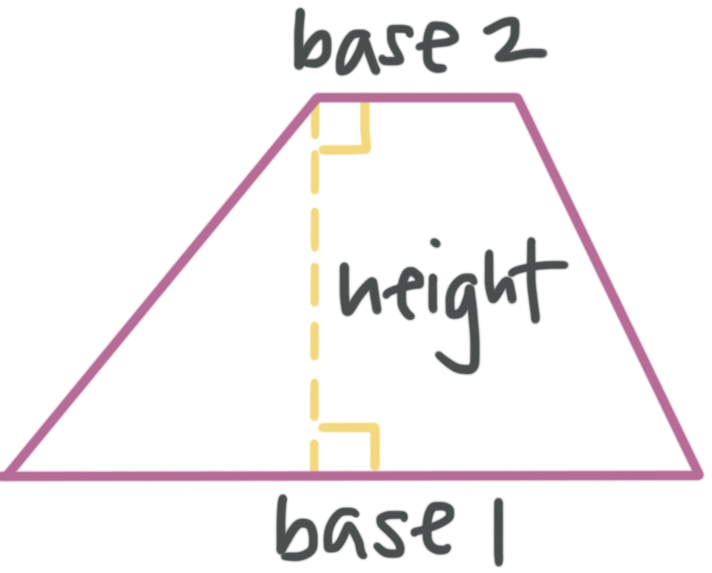
We add the base lengths, divide by two to find their average, then multiply by the height. Because we’re multiplying lengths, the result is measured in square units.
Example: Use the given dimensions
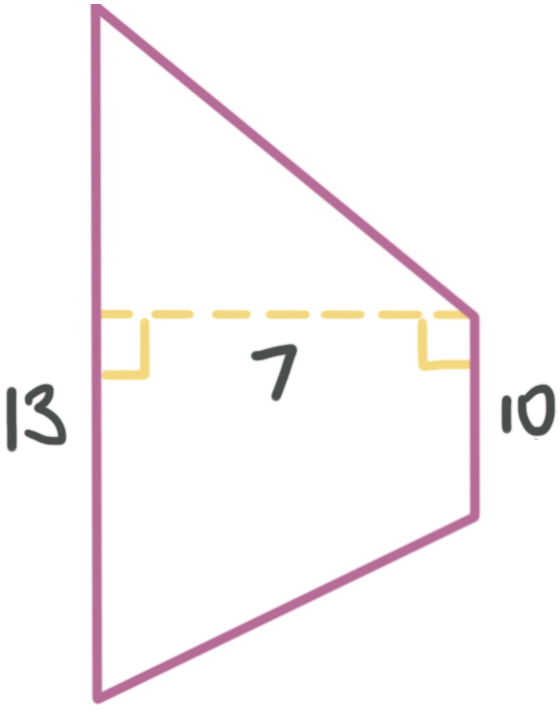
Find the area of the trapezoid. Its parallel bases have lengths and , and the perpendicular height is .
Example: Find the dimensions on a grid
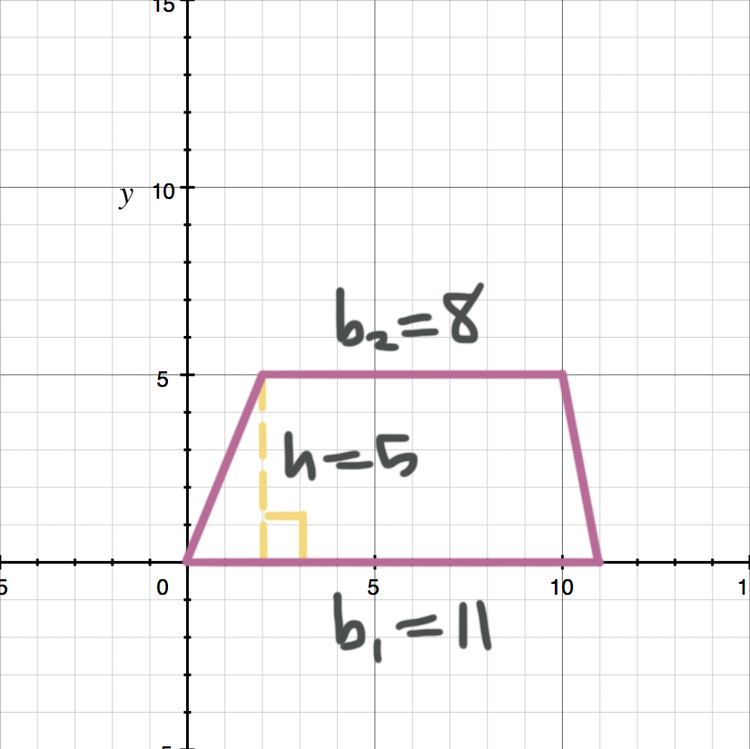
Find the area of the trapezoid on the coordinate grid. We’ll use the grid to count the lengths of the parallel bases and the perpendicular distance between them.

Counting the grid units gives base lengths of and and a height of . The height is measured across the gap between the parallel bases, along a perpendicular line.
The process is the same whether the dimensions are labeled or found from a grid: identify the two parallel bases and their perpendicular height, then substitute those three lengths into the area formula.
Related lesson: How to find the area of a parallelogram.