Skip to content
Krista King at a table with her laptop and notebooks

You can be
great at math.

I’ll help you make sense of math, one step at a time. Start wherever you are, from Pre-Algebra through Linear Algebra.

340,000+
students taught
275,000+
YouTube subscribers
20+ years
tutoring
“I have earned not one, but two As in the calculus courses I completed over the past year. I would have been happy with Bs, but you helped push me further and I feel like I really earned the As.”
Kevin H. · Back to calculus after 10 years

Find your course.

Start with the class you're taking now, or build the foundation that makes it easier.

Not sure where to start?

Find your starting pointAnswer a few questions and I'll show you the exact lesson to start with. Get a custom learning pathSend me your syllabus or assignments and I'll build a path through the lessons that follows your class.
See all 12 courses

Here’s how every lesson works.

Clear notes, a video of me explaining the concept and working an example, then practice questions to prove you’ve got it.

Changes the notes, video, quiz, extra practice, tutor example, and backgrounds together.

Choose your course

Start with the notes.

Every key idea and worked example you need, all in one place.

RoundingPre-Algebra
Rounding, page 1 of 4Rounding, page 2 of 4Rounding, page 3 of 4Rounding, page 4 of 4

4 pages · Scroll to read

Dividing polynomialsAlgebra 1
Dividing polynomials, page 1 of 6Dividing polynomials, page 2 of 6Dividing polynomials, page 3 of 6Dividing polynomials, page 4 of 6Dividing polynomials, page 5 of 6Dividing polynomials, page 6 of 6

6 pages · Scroll to read

Scalene, isosceles, and equilateral trianglesGeometry
Scalene, isosceles, and equilateral triangles, page 1 of 5Scalene, isosceles, and equilateral triangles, page 2 of 5
Scalene, isosceles, and equilateral triangles, page 3 of 5
2. If exactly two sides are equal, classify the triangle as isosceles.
    If all three sides are equal, go to Step 3.
Scalene, isosceles, and equilateral triangles, page 4 of 5Scalene, isosceles, and equilateral triangles, page 5 of 5

5 pages · Scroll to read

Graphing circlesAlgebra 2
Graphing circles, page 1 of 5Graphing circles, page 2 of 5Graphing circles, page 3 of 5Graphing circles, page 4 of 5Graphing circles, page 5 of 5

5 pages · Scroll to read

Sine, cosine, and tangentTrigonometry
Sine, cosine, and tangent, page 1 of 6Sine, cosine, and tangent, page 2 of 6Sine, cosine, and tangent, page 3 of 6Sine, cosine, and tangent, page 4 of 6Sine, cosine, and tangent, page 5 of 6Sine, cosine, and tangent, page 6 of 6

6 pages · Scroll to read

Polar coordinatesPrecalculus
Polar coordinates, page 1 of 8Polar coordinates, page 2 of 8Polar coordinates, page 3 of 8Polar coordinates, page 4 of 8Polar coordinates, page 5 of 8Polar coordinates, page 6 of 8Polar coordinates, page 7 of 8
Polar coordinates, page 8 of 8
For r > 0, use the signs of x and y to find the angle θ.
At the origin, r = 0 and any angle works.

8 pages · Scroll to read

Box-and-whisker plotsProbability & Statistics
Box-and-whisker plots, page 1 of 4Box-and-whisker plots, page 2 of 4Box-and-whisker plots, page 3 of 4Box-and-whisker plots, page 4 of 4

4 pages · Scroll to read

Idea of the limitCalculus 1
Idea of the limit, page 1 of 3
Idea of the limit, page 2 of 3
The limit is 6 because f(x) = x + 1 is continuous at x = 5. Its values approach 6 from both sides, and f(5) = 6. In limit notation, here’s how that looks:
Since √x + 2 is continuous at 16, substitute x = 16.
Idea of the limit, page 3 of 3

3 pages · Scroll to read

Over and underestimationCalculus 2
Over and underestimation, page 1 of 6Over and underestimation, page 2 of 6Over and underestimation, page 3 of 6
Over and underestimation, page 4 of 6
Estimate the area under f(x) = √(x + 5) on [−5, 20]. Use five unequal subintervals with endpoints where x + 5 is a perfect square. Choose sample points that give the largest estimate for this partition.
Over and underestimation, page 5 of 6
The function increases on [−5, 20], so left endpoints underestimate the area and right endpoints overestimate it. Right endpoints give the largest sum for these subintervals.
Choose endpoints where x + 5 equals 0, 1, 4, 9, 16, or 25. Then the heights √(x + 5) are 0, 1, 2, 3, 4, and 5.
Over and underestimation, page 6 of 6

6 pages · Scroll to read

Direction cosines and direction anglesCalculus 3
Direction cosines and direction angles, page 1 of 4Direction cosines and direction angles, page 2 of 4Direction cosines and direction angles, page 3 of 4Direction cosines and direction angles, page 4 of 4

4 pages · Scroll to read

Autonomous equations and equilibrium solutionsDifferential Equations
Autonomous equations and equilibrium solutions, page 1 of 12
So far we’ve looked at linear and nonlinear first-order ordinary differential equations. Now we’ll focus on autonomous equations. They can be linear or nonlinear.
Where f(y) ≠ 0, we can separate variables. Check any zeros of f(y) separately for equilibrium solutions.
Autonomous equations and equilibrium solutions, page 2 of 12Autonomous equations and equilibrium solutions, page 3 of 12Autonomous equations and equilibrium solutions, page 4 of 12Autonomous equations and equilibrium solutions, page 5 of 12Autonomous equations and equilibrium solutions, page 6 of 12Autonomous equations and equilibrium solutions, page 7 of 12Autonomous equations and equilibrium solutions, page 8 of 12Autonomous equations and equilibrium solutions, page 9 of 12Autonomous equations and equilibrium solutions, page 10 of 12Autonomous equations and equilibrium solutions, page 11 of 12Autonomous equations and equilibrium solutions, page 12 of 12

12 pages · Scroll to read

Equation of a plane, and normal vectorsLinear Algebra
Equation of a plane, and normal vectors, page 1 of 7
A plane is determined by a point on it and a nonzero normal vector. For any two points in the plane, the vector connecting them is orthogonal to the normal. A plane can pass through the origin or be shifted away from it.
Equation of a plane, and normal vectors, page 2 of 7Equation of a plane, and normal vectors, page 3 of 7Equation of a plane, and normal vectors, page 4 of 7Equation of a plane, and normal vectors, page 5 of 7Equation of a plane, and normal vectors, page 6 of 7
Equation of a plane, and normal vectors, page 7 of 7
Multiplying the equation by any nonzero scalar gives another equation for the same plane. Its coefficients give another normal vector. Positive scalars keep the same direction, and negative scalars reverse it.

7 pages · Scroll to read

Watch me explain the topic.

We’ll start with the big idea and work through an example together.

RoundingPre-Algebra
Dividing polynomialsAlgebra 1
Scalene, isosceles, and equilateral trianglesGeometry
Graphing circlesAlgebra 2
Sine, cosine, and tangentTrigonometry
Polar coordinatesPrecalculus
Box-and-whisker plotsProbability & Statistics
Idea of the limitCalculus 1
Over and underestimationCalculus 2
Direction cosines and direction anglesCalculus 3
Autonomous equations and equilibrium solutionsDifferential Equations
Equation of a plane, and normal vectorsLinear Algebra

Try a question, then see the full solution.

Find out what you know and what to practice next.

RoundingPre-Algebra
Round to the nearest hundredth.
0.738620.73862
You got it!
Try again.
See the worked solution
Rounding worked solution, page 1 of 1
Dividing polynomialsAlgebra 1
Simplify the expression.
(x2+x+8)÷(x−1)(x^2+x+8)\div\left(x-1\right)
You got it!
Try again.
See the worked solution
Dividing polynomials worked solution, page 1 of 1
Scalene, isosceles, and equilateral trianglesGeometry
Choose the value that can be the measure of a base angle of an isosceles triangle.
You got it!
Try again.
See the worked solution
Scalene, isosceles, and equilateral triangles worked solution, page 1 of 1
Graphing circlesAlgebra 2
Which circle is the graph of (x−2)2+(y+3)2=4(x-2)^2+(y+3)^2=4?
Four circle graphs labeled A through D.
You got it!
Try again.
See the worked solution
Graphing circles worked solution, page 1 of 1
Sine, cosine, and tangentTrigonometry
In the right triangle ABCABC, cos∠C=3/5\cos \angle{C}=3/5. If the adjacent side has length 3030, what is the length of the hypotenuse?
You got it!
Try again.
See the worked solution
Sine, cosine, and tangent worked solution, page 1 of 1
Polar coordinatesPrecalculus
What are the rectangular coordinates (x,y)(x,y) of the point that has polar coordinates (r,θ)=(4,π)(r,\theta)=(4,\pi)?
You got it!
Try again.
See the worked solution
Polar coordinates worked solution, page 1 of 1
Box-and-whisker plotsProbability & Statistics
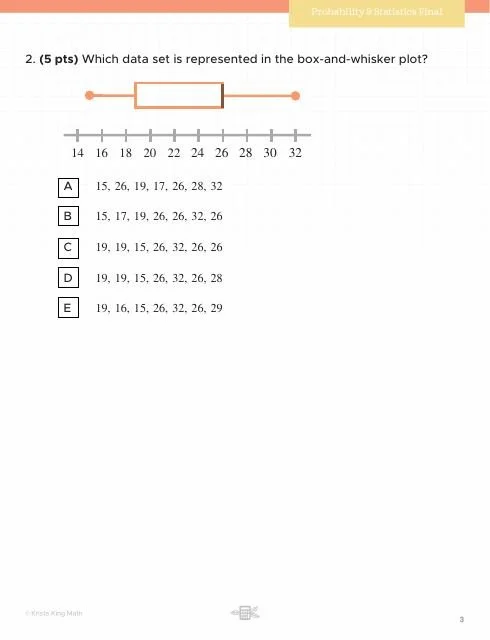
The box plot shows the number of hours slept on vacation. What is the median of the data?
Box plot of hours slept on vacation.
You got it!
Try again.
See the worked solution
Box-and-whisker plots worked solution, page 1 of 1
Idea of the limitCalculus 1
Evaluate the limit.
limx→3x−6x\lim_{x\to3}\frac{x-6}{x}
You got it!
Try again.
See the worked solution
Idea of the limit worked solution, page 1 of 1
Over and underestimationCalculus 2
Use Riemann sums to find the smallest and largest estimations of the area under f(x)f(x) on [1,6][1,6] with n=5n=5 subintervals.
f(x)=18x2−14x+12f(x) = \frac{1}{8}{x^2} - \frac{1}{4}x + \frac{1}{2}
You got it!
Try again.
See the worked solution
Over and underestimation worked solution, page 1 of 3Over and underestimation worked solution, page 2 of 3Over and underestimation worked solution, page 3 of 3
Direction cosines and direction anglesCalculus 3
Find the direction cosines of a=⟨5,6⟩a=\langle5,6\rangle.
You got it!
Try again.
See the worked solution
Direction cosines and direction angles worked solution, page 1 of 1
Autonomous equations and equilibrium solutionsDifferential Equations
Find any equilibrium solutions of the autonomous differential equation, then determine whether each solution is stable, unstable, or semi-stable.
dydt=4y−4y2\frac{dy}{dt} =4y-4y^{2}
You got it!
Try again.
See the worked solution
Autonomous equations and equilibrium solutions worked solution, page 1 of 2Autonomous equations and equilibrium solutions worked solution, page 2 of 2
Equation of a plane, and normal vectorsLinear Algebra
What is the normal vector to the plane?
3x+5y+9z=−263x+5y+9z=-26
You got it!
Try again.
See the worked solution
Equation of a plane, and normal vectors worked solution, page 1 of 1
Extra practicePre-AlgebraAlgebra 1GeometryAlgebra 2TrigonometryPrecalculusProbability & StatisticsCalculus 1Calculus 2Calculus 3Differential EquationsLinear Algebra

Even more resources for every course.

Get all the extra practice you need, then check that you’re ready before test day.

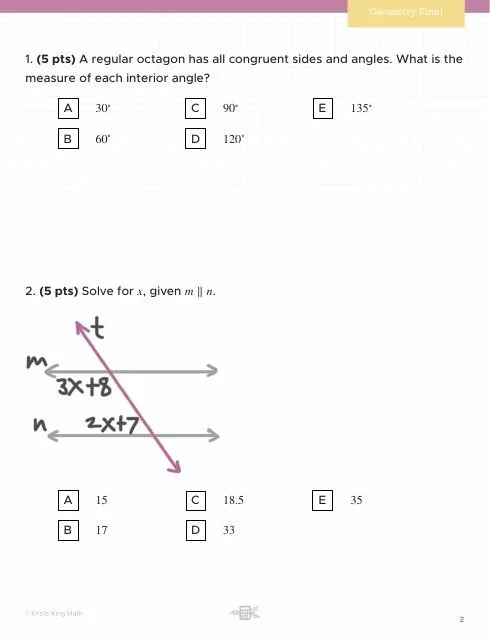
  • Pre-Algebra worksheets, page 15Pre-Algebra worksheets, page 2Pre-Algebra worksheets, page 10

    Worksheets

    Review the key ideas and try a few problems.

  • Pre-Algebra practice workbooks, page 7Pre-Algebra practice workbooks, page 9Pre-Algebra practice workbooks, page 10

    Practice workbooks

    Extra problems, with solutions to check your work.

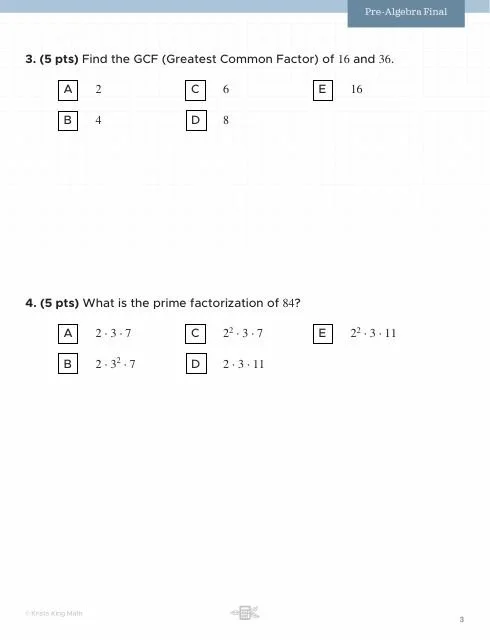
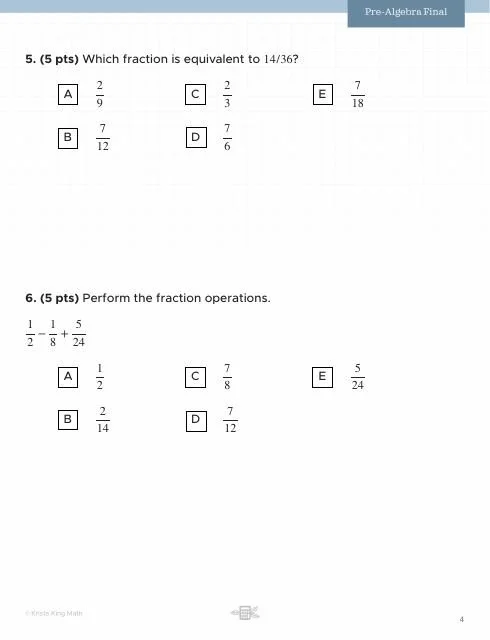
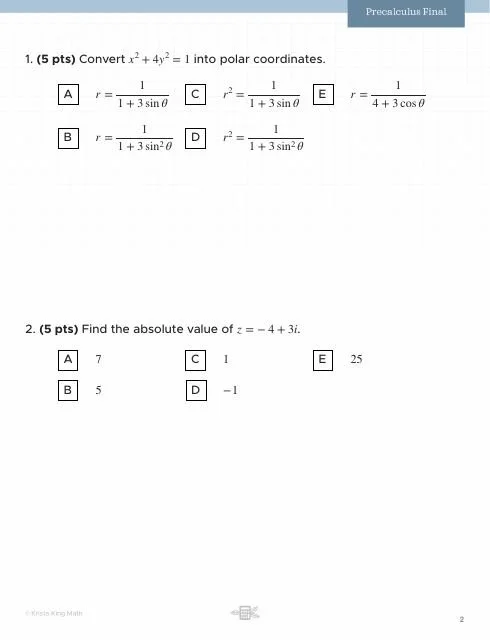
  • Pre-Algebra final exams, page 3Pre-Algebra final exams, page 4Pre-Algebra final exams, page 5

    Final exams

    A practice run before test day.

  • Pre-Algebra formula sheets, page 6Pre-Algebra formula sheets, page 7Pre-Algebra formula sheets, page 8

    Formula sheets

    The key formulas, all in one place.

  • Algebra 1 worksheets, page 15Algebra 1 worksheets, page 14Algebra 1 worksheets, page 23

    Worksheets

    Review the key ideas and try a few problems.

  • Algebra 1 practice workbooks, page 37Algebra 1 practice workbooks, page 41Algebra 1 practice workbooks, page 80

    Practice workbooks

    Extra problems, with solutions to check your work.

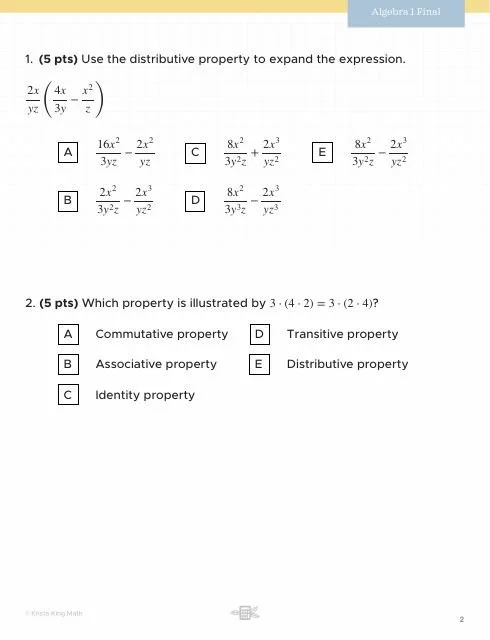
  • Algebra 1 final exams, page 3Algebra 1 final exams, page 4Algebra 1 final exams, page 7

    Final exams

    A practice run before test day.

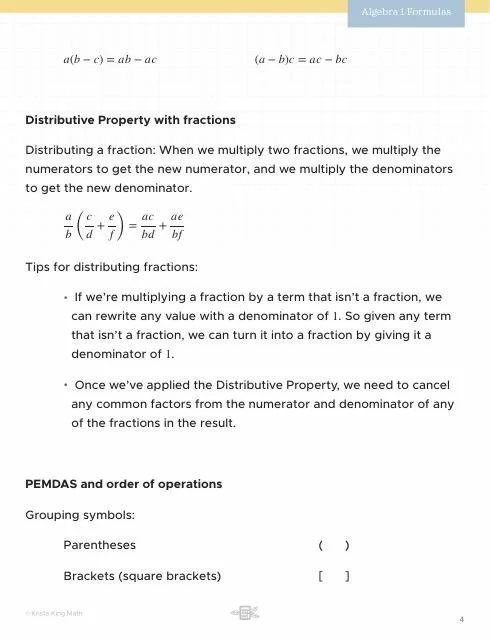
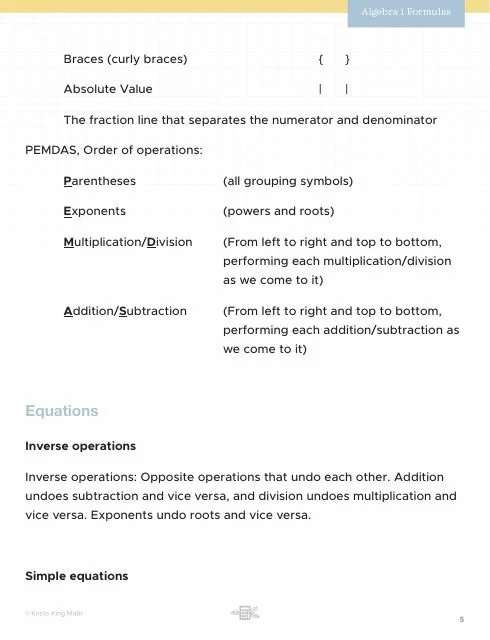
  • Algebra 1 formula sheets, page 4Algebra 1 formula sheets, page 5Algebra 1 formula sheets, page 6

    Formula sheets

    The key formulas, all in one place.

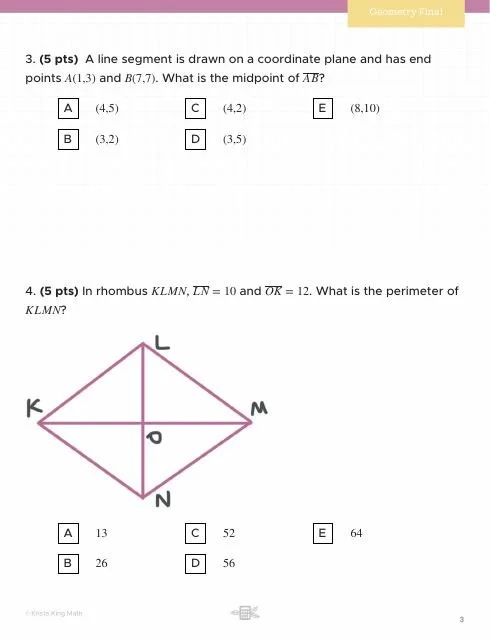
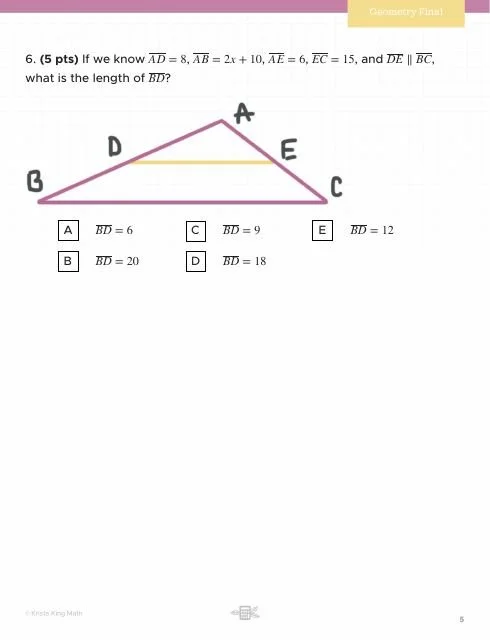
  • Geometry worksheets, page 13Geometry worksheets, page 32Geometry worksheets, page 49

    Worksheets

    Review the key ideas and try a few problems.

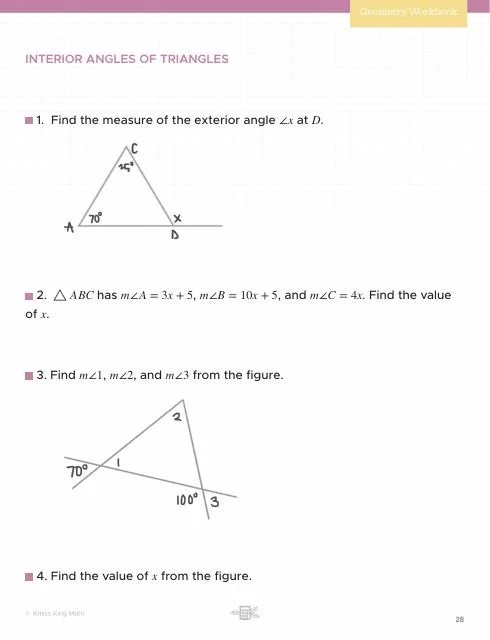
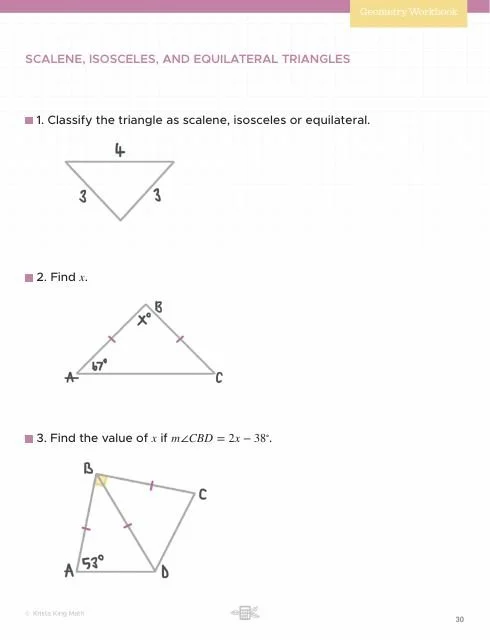
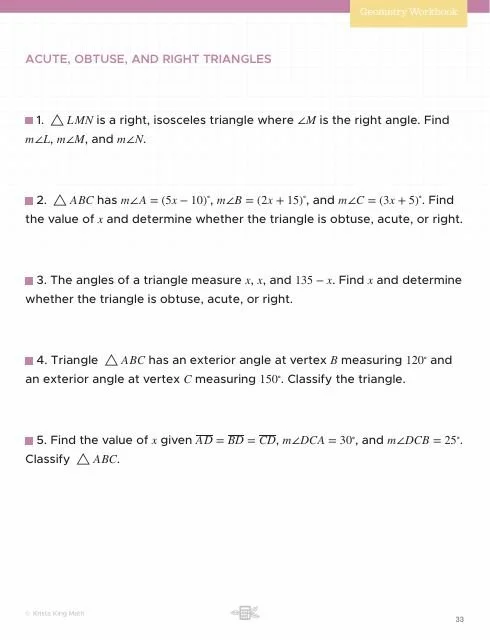
  • Geometry practice workbooks, page 29Geometry practice workbooks, page 31Geometry practice workbooks, page 34

    Practice workbooks

    Extra problems, with solutions to check your work.

  • Geometry final exams, page 3Geometry final exams, page 4Geometry final exams, page 6

    Final exams

    A practice run before test day.

  • Geometry formula sheets, page 31Geometry formula sheets, page 5Geometry formula sheets, page 18

    Formula sheets

    The key formulas, all in one place.

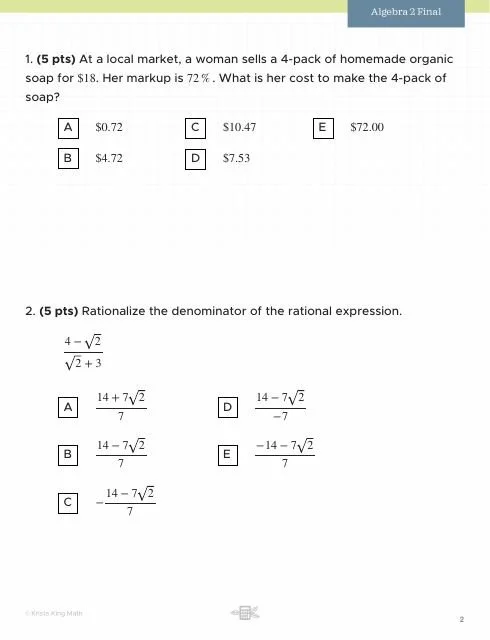
  • Algebra 2 worksheets, page 28Algebra 2 worksheets, page 6Algebra 2 worksheets, page 7

    Worksheets

    Review the key ideas and try a few problems.

  • Algebra 2 practice workbooks, page 89Algebra 2 practice workbooks, page 92Algebra 2 practice workbooks, page 106

    Practice workbooks

    Extra problems, with solutions to check your work.

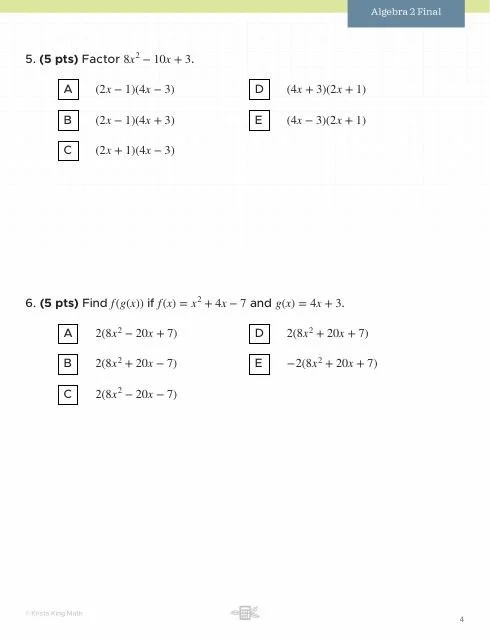
  • Algebra 2 final exams, page 3Algebra 2 final exams, page 5Algebra 2 final exams, page 6

    Final exams

    A practice run before test day.

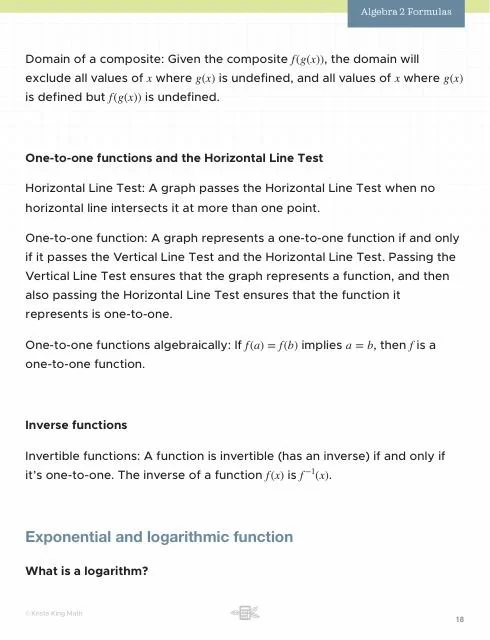
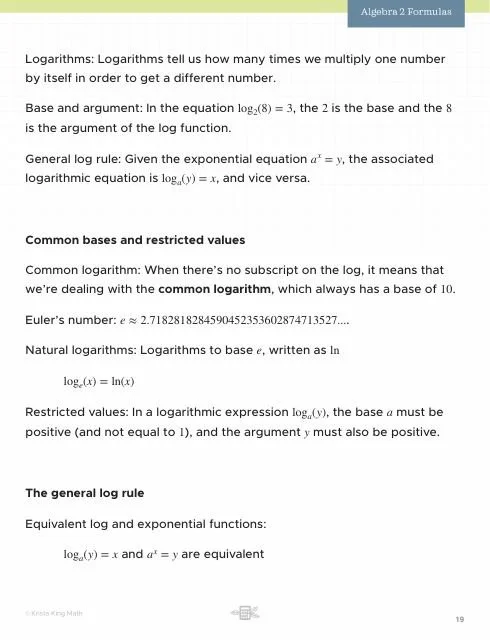
  • Algebra 2 formula sheets, page 8Algebra 2 formula sheets, page 19Algebra 2 formula sheets, page 20

    Formula sheets

    The key formulas, all in one place.

  • Trigonometry worksheets, page 6Trigonometry worksheets, page 10Trigonometry worksheets, page 20

    Worksheets

    Review the key ideas and try a few problems.

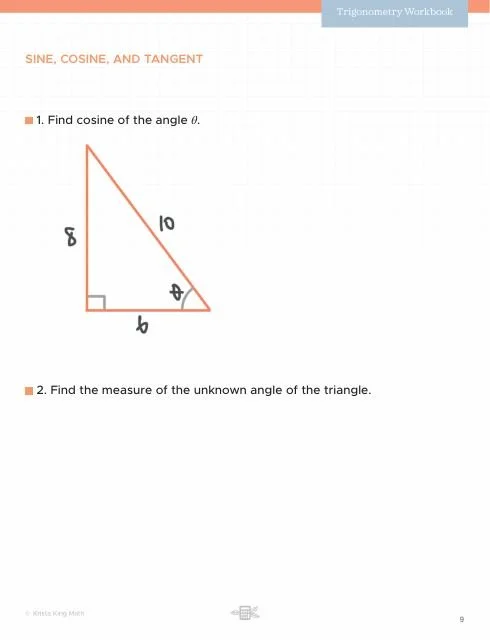
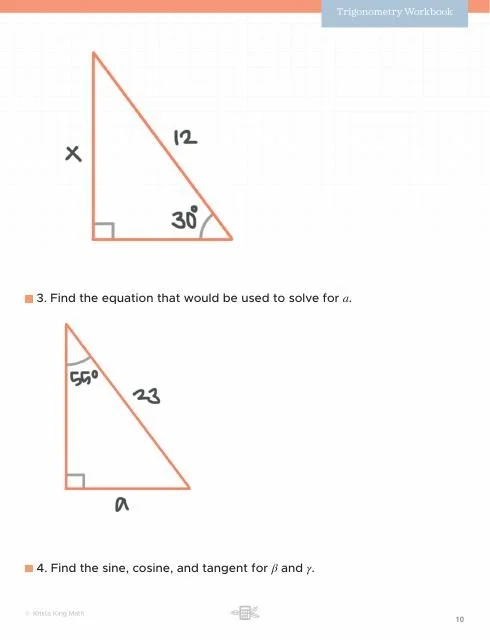
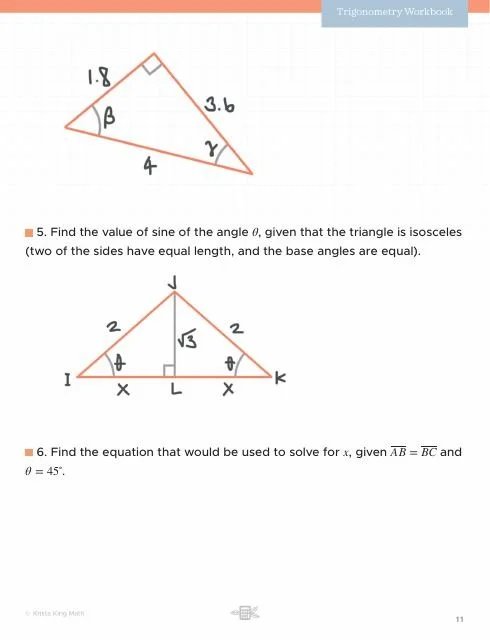
  • Trigonometry practice workbooks, page 10Trigonometry practice workbooks, page 11Trigonometry practice workbooks, page 12

    Practice workbooks

    Extra problems, with solutions to check your work.

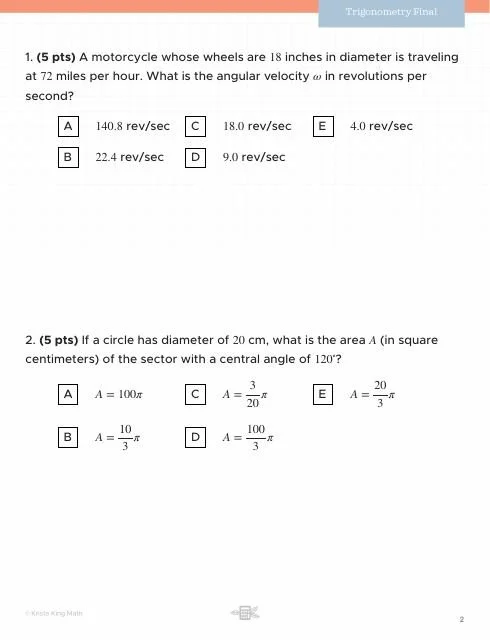
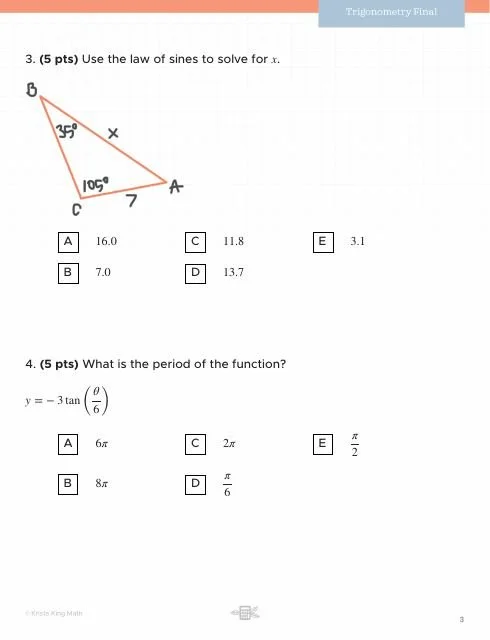
  • Trigonometry final exams, page 3Trigonometry final exams, page 4Trigonometry final exams, page 5

    Final exams

    A practice run before test day.

  • Trigonometry formula sheets, page 8Trigonometry formula sheets, page 9Trigonometry formula sheets, page 10

    Formula sheets

    The key formulas, all in one place.

  • Precalculus worksheets, page 15Precalculus worksheets, page 22Precalculus worksheets, page 28

    Worksheets

    Review the key ideas and try a few problems.

  • Precalculus practice workbooks, page 19Precalculus practice workbooks, page 43Precalculus practice workbooks, page 66

    Practice workbooks

    Extra problems, with solutions to check your work.

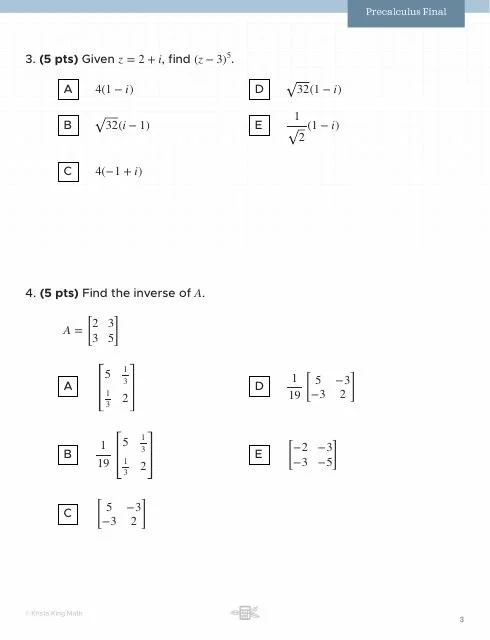
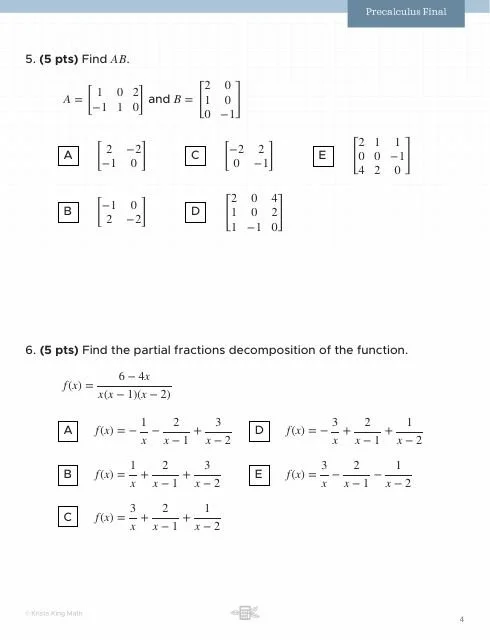
  • Precalculus final exams, page 3Precalculus final exams, page 4Precalculus final exams, page 5

    Final exams

    A practice run before test day.

  • Precalculus formula sheets, page 24Precalculus formula sheets, page 26Precalculus formula sheets, page 21

    Formula sheets

    The key formulas, all in one place.

  • Probability & Statistics worksheets, page 6Probability & Statistics worksheets, page 2Probability & Statistics worksheets, page 3

    Worksheets

    Review the key ideas and try a few problems.

  • Probability & Statistics practice workbooks, page 7Probability & Statistics practice workbooks, page 49Probability & Statistics practice workbooks, page 22

    Practice workbooks

    Extra problems, with solutions to check your work.

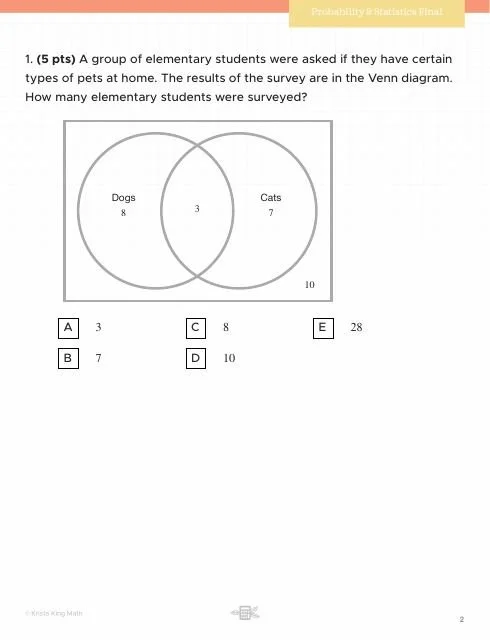
  • Probability & Statistics final exams, page 3Probability & Statistics final exams, page 4Probability & Statistics final exams, page 5

    Final exams

    A practice run before test day.

  • Probability & Statistics formula sheets, page 12Probability & Statistics formula sheets, page 13Probability & Statistics formula sheets, page 15

    Formula sheets

    The key formulas, all in one place.

  • Calculus 1 worksheets, page 7Calculus 1 worksheets, page 2Calculus 1 worksheets, page 13

    Worksheets

    Review the key ideas and try a few problems.

  • Calculus 1 practice workbooks, page 41Calculus 1 practice workbooks, page 10Calculus 1 practice workbooks, page 19

    Practice workbooks

    Extra problems, with solutions to check your work.

  • Calculus 1 final exams, page 32Calculus 1 final exams, page 3Calculus 1 final exams, page 37

    Final exams

    A practice run before test day.

  • Calculus 1 formula sheets, page 14Calculus 1 formula sheets, page 12Calculus 1 formula sheets, page 15

    Formula sheets

    The key formulas, all in one place.

  • Calculus 2 worksheets, page 129Calculus 2 worksheets, page 65Calculus 2 worksheets, page 97

    Worksheets

    Review the key ideas and try a few problems.

  • Calculus 2 practice workbooks, page 118Calculus 2 practice workbooks, page 116Calculus 2 practice workbooks, page 117

    Practice workbooks

    Extra problems, with solutions to check your work.

  • Calculus 2 final exams, page 83Calculus 2 final exams, page 4Calculus 2 final exams, page 5

    Final exams

    A practice run before test day.

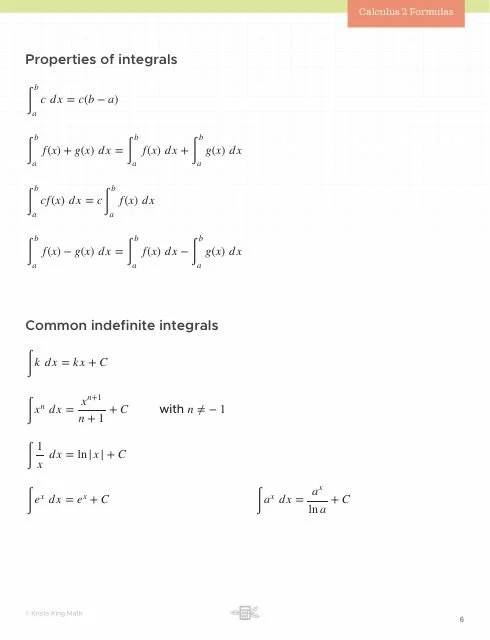
  • Calculus 2 formula sheets, page 2Calculus 2 formula sheets, page 4Calculus 2 formula sheets, page 7

    Formula sheets

    The key formulas, all in one place.

  • Calculus 3 practice workbooks, page 129Calculus 3 practice workbooks, page 8Calculus 3 practice workbooks, page 144

    Practice workbooks

    Extra problems, with solutions to check your work.

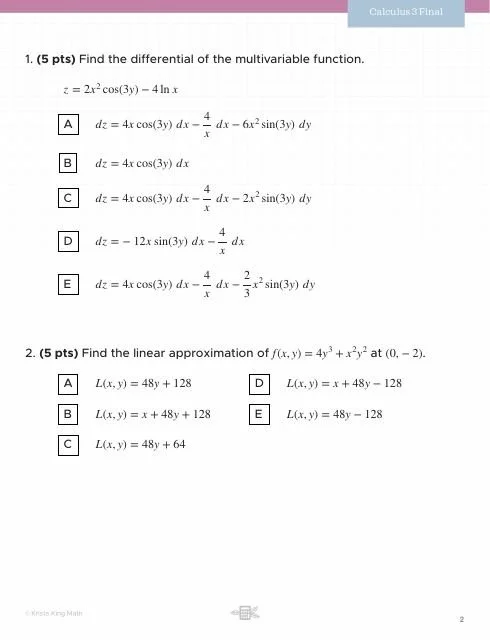
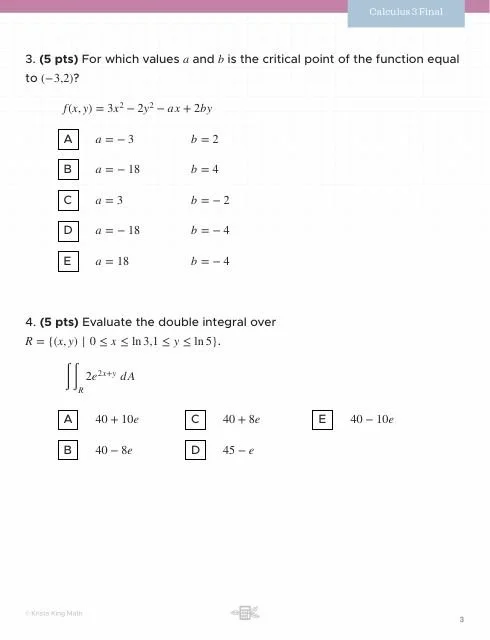
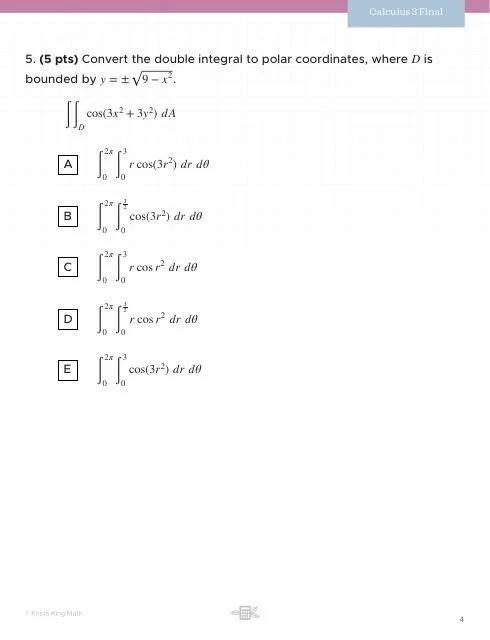
  • Calculus 3 final exams, page 3Calculus 3 final exams, page 4Calculus 3 final exams, page 5

    Final exams

    A practice run before test day.

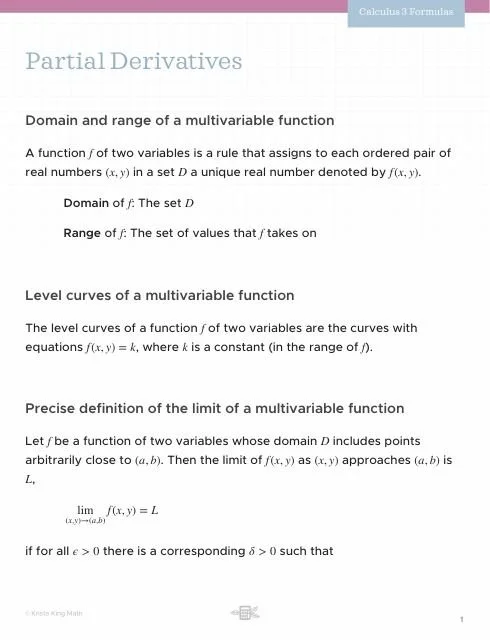
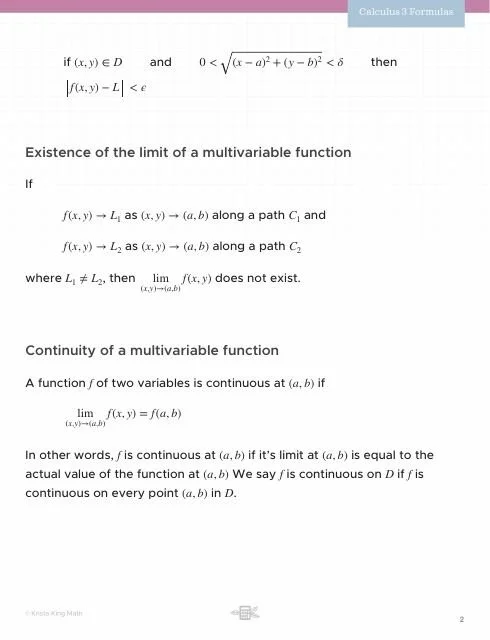
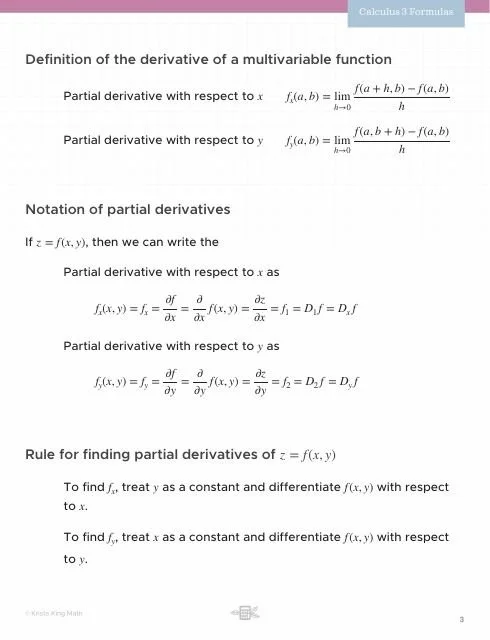
  • Calculus 3 formula sheets, page 2Calculus 3 formula sheets, page 3Calculus 3 formula sheets, page 4

    Formula sheets

    The key formulas, all in one place.

  • Differential Equations worksheets, page 45Differential Equations worksheets, page 44Differential Equations worksheets, page 62

    Worksheets

    Review the key ideas and try a few problems.

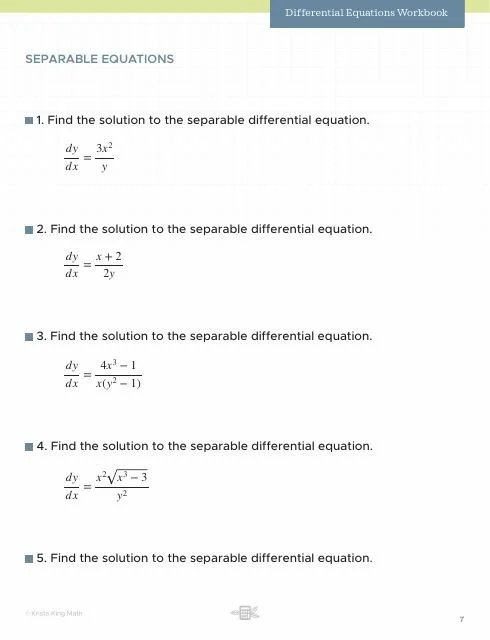
  • Differential Equations practice workbooks, page 8Differential Equations practice workbooks, page 9Differential Equations practice workbooks, page 10

    Practice workbooks

    Extra problems, with solutions to check your work.

  • Differential Equations final exams, page 3Differential Equations final exams, page 4Differential Equations final exams, page 5

    Final exams

    A practice run before test day.

  • Differential Equations formula sheets, page 42Differential Equations formula sheets, page 18Differential Equations formula sheets, page 20

    Formula sheets

    The key formulas, all in one place.

  • Linear Algebra worksheets, page 30Linear Algebra worksheets, page 6Linear Algebra worksheets, page 33

    Worksheets

    Review the key ideas and try a few problems.

  • Linear Algebra practice workbooks, page 77Linear Algebra practice workbooks, page 42Linear Algebra practice workbooks, page 95

    Practice workbooks

    Extra problems, with solutions to check your work.

  • Linear Algebra final exams, page 3Linear Algebra final exams, page 4Linear Algebra final exams, page 5

    Final exams

    A practice run before test day.

  • Linear Algebra formula sheets, page 16Linear Algebra formula sheets, page 29Linear Algebra formula sheets, page 17

    Formula sheets

    The key formulas, all in one place.

Personal supportPre-AlgebraAlgebra 1GeometryAlgebra 2TrigonometryPrecalculusProbability & StatisticsCalculus 1Calculus 2Calculus 3Differential EquationsLinear Algebra

You’re never on your own.

Real help, right when you need it.

KristaYour teacher
Krista²AI math tutor

I teach every lesson. If you get stuck, Krista², my AI tutor, is there day or night. She’ll guide you through the thinking step-by-step. And, of course, you can always reach out to me directly. 🤓

Krista²
Question:

For −1 + 8, I got −9 because I added 1 and 8 and kept the minus sign. What am I doing wrong?

Krista²’s response:

The minus sign belongs to the 11, not to the whole sum. Because −1-1 and 88 have opposite signs, they partly cancel rather than combining into a larger negative number.

Think of a number line: start at −1-1. Adding positive 88 means moving 8 units to the right. Where do you land?

Example conversation · Pre-Algebra
Krista²
Question:

I’m solving 3(x − 4) = 2x + 5. I expanded it to 3x − 4 = 2x + 5, then got x = 9. It fails when I check it. Where did I mess up?

Krista²’s response:

The first error is in the expansion. The 33 multiplies both terms inside the parentheses, including −4-4:

3(x−4)=3x−12.3(x-4)=3x-12.

So your equation becomes

3x−12=2x+5.3x-12=2x+5.

Your later algebra was consistent with the expansion you wrote; it’s that expansion that changed the equation. What do you get if you subtract 2x2x from both sides of the corrected equation?

Example conversation · Algebra 1
Krista²
Question:

A triangle has an exterior angle of 125° and one of the other interior angles is 18°. I did 180 − 125 − 18 = 37° for the missing angle. Is my setup right?

Krista²’s response:

Not quite: your setup uses 125∘125^\circ as though it were an interior angle, but it’s an exterior angle.

An exterior angle equals the sum of the two interior angles that aren’t next to it. So if xx is the missing angle, we have

x+18∘=125∘.x+18^\circ=125^\circ.

What operation would you use to isolate xx?

Example conversation · Geometry
Krista²
Question:

I rewrote log₈(x) = 4 as x = 8 × 4 = 32. My notes say that’s wrong. What did I mix up?

Krista²’s response:

You mixed up an exponent with multiplication. A logarithm tells us what exponent to put on the base.

log⁡8(x)=4\log_8(x)=4

means “8 raised to what power equals xx?” The logarithm says that power is 4, so the correct rewrite is

x=84.x=8^4.

That means multiplying four factors of 8, rather than multiplying 8 by 4. Can you evaluate 848^4?

Example conversation · Algebra 2
Krista²
Question:

I know cos C = 3/5 and the adjacent side is 30. I multiplied 30 by 3/5 and got 18 for the hypotenuse. Why is that wrong?

Krista²’s response:

Your multiplication is correct, but the ratio is being used in the wrong direction. Cosine means

cos⁡C=adjacenthypotenuse.\cos C=\dfrac{\text{adjacent}}{\text{hypotenuse}}.

So cos⁡C=3/5\cos C=3/5 tells us the adjacent side is 3/53/5 of the hypotenuse, not the other way around. With adjacent side 3030, we have

35=30h,\dfrac{3}{5}=\dfrac{30}{h},

or equivalently,

30=35h.30=\dfrac{3}{5}h.

Also, 1818 can’t be the hypotenuse because the hypotenuse must be longer than the adjacent side, 3030.

What operation would undo multiplying hh by 3/53/5?

Example conversation · Trigonometry
Krista²
Question:

For the polar point (4, π), I used x = 4 because r is 4, and y = 0 because π is on the x-axis. Why isn’t (4, 0) correct?

Krista²’s response:

You’re right that y=0y=0, because the angle π\pi points along the x-axis. The key is which direction along that axis.

In polar coordinates, r=4r=4 means move 4 units in the direction given by the angle. Since π\pi radians is 180∘180^\circ, that direction is left, along the negative x-axis. So r=4r=4 doesn’t mean x=4x=4.

Using the conversion formulas:

x=rcos⁡θ=4cos⁡π=−4x=r\cos\theta=4\cos\pi=-4 y=rsin⁡θ=4sin⁡π=0.y=r\sin\theta=4\sin\pi=0.

The rectangular point is therefore (−4,0)\boxed{(-4,0)}: 4 units left of the origin.

Example conversation · Precalculus
Krista²
Question:

A normal distribution has mean 150 and standard deviation 28. For 94 to 206 I used 68% because it’s one interval. What am I missing?

Krista²’s response:

The key is how many standard deviations the endpoints are from the mean, not how many intervals are written.

Both endpoints are 5656 units from 150150. Since the standard deviation is 2828,

5628=2.\dfrac{56}{28}=2.

So 9494 to 206206 covers two standard deviations below and above the mean. The 68%68\% rule applies within one standard deviation of the mean.

According to the empirical rule, what percentage falls within two standard deviations?

Example conversation · Probability & Statistics
Krista²
Question:

I canceled the x’s in (x − 6)/x and got 1 − 6 = −5. Is that how I find the limit as x approaches 3?

Krista²’s response:

Not quite. Canceling works for factors multiplying the whole numerator and denominator. In x−6x-6, the xx is only one term, so we can’t cancel it out of the whole numerator.

Instead, divide each numerator term by xx:

x−6x=xx−6x=1−6x(x≠0).\dfrac{x-6}{x} =\dfrac{x}{x}-\dfrac{6}{x} =1-\dfrac{6}{x} \qquad (x\ne 0).

Since the denominator isn’t zero at x=3x=3, we can find the limit by substitution. What do you get when you substitute 33 for xx in this corrected expression?

Example conversation · Calculus 1
Krista²
Question:

For ∫ x cos x dx, I chose u = cos x and dv = x dx. Now the integral is getting harder. How do I choose better?

Krista²’s response:

Your choice is valid, but differentiating cos⁡x\cos x keeps producing trig functions, while integrating xx raises its degree. That makes the remaining integral harder.

For integration by parts, aim to choose uu so it gets simpler when differentiated, and dvdv so it’s easy to integrate. Here, a better choice is

u=x,dv=cos⁡x dx.u=x,\qquad dv=\cos x\,dx.

Then

du=dx,v=sin⁡x.du=dx,\qquad v=\sin x.

Using the integration-by-parts formula,

∫u dv=uv−∫v du,\int u\,dv=uv-\int v\,du,

we get

∫xcos⁡x dx=xsin⁡x−∫sin⁡x dx.\int x\cos x\,dx=x\sin x-\int\sin x\,dx.

Now the remaining integral is simpler because the factor xx is gone. What antiderivative would you use for sin⁡x\sin x?

Example conversation · Calculus 2
Krista²
Question:

For f(x, y) = 4x³y², I found ∂f/∂y = 12x² · 2y. Why is that wrong?

Krista²’s response:

When taking a partial derivative with respect to yy, we treat xx as a constant. So 4x34x^3 stays unchanged, and only y2y^2 is differentiated:

∂f∂y=4x3⋅2y=8x3y.\dfrac{\partial f}{\partial y} =4x^3\cdot 2y =8x^3y.

Your derivative of y2y^2, which is 2y2y, is correct. The error is changing 4x34x^3 into 12x212x^2: that would be differentiating it with respect to xx, but here we’re differentiating with respect to yy.

Example conversation · Calculus 3
Krista²
Question:

For dy/dx = sec²x/tan²y, I divided by tan²y and got dy/tan²y = sec²x dx. Am I separating this correctly?

Krista²’s response:

Not quite. Since tan⁡2y\tan^2 y is in the denominator on the right, we multiply both sides by tan⁡2y\tan^2 y to cancel it, then multiply by dxdx:

tan⁡2y dy=sec⁡2x dx.\tan^2 y\,dy=\sec^2 x\,dx.

Now all the yy-terms are on the left and all the xx-terms are on the right, so the variables are separated.

Can you rewrite tan⁡2y\tan^2 y using the identity 1+tan⁡2y=sec⁡2y1+\tan^2 y=\sec^2 y to prepare the left side for integration?

Example conversation · Differential Equations
Krista²
Question:

For R₁ ↔ R₂, I swapped just the first numbers in the two rows. My answer is wrong. What does that symbol tell me to do?

Krista²’s response:

The symbol R1↔R2R_1 \leftrightarrow R_2 means swap the entire first and second rows, not just their first entries. Every entry moves with its row, including the number after the divider in an augmented matrix.

For example,

[12∣734∣8]⟶[34∣812∣7].\begin{bmatrix} 1 & 2 & \mid & 7\\ 3 & 4 & \mid & 8 \end{bmatrix} \quad\longrightarrow\quad \begin{bmatrix} 3 & 4 & \mid & 8\\ 1 & 2 & \mid & 7 \end{bmatrix}.

Try your swap again, moving each whole row into the other row’s position.

Example conversation · Linear Algebra

What students have gone on to do.

These students are just like you. They came, they studied, they conquered. We’ve got this. 👊

“My son has used your courses for all of his high school math and just started college as a double major in aerospace engineering and astrophysics. He loved your courses enough that he is planning to use them for reference while in college!”
Kimberly E.Homeschool parent
“I passed my exams and was subsequently accepted to study a BSc Mathematics and Economics degree at the University of London, London School of Economics. All this at the age of 34, after failing math in high school back in 1998.”
Lawrence D.Returned to math at 34
“I took calculus for the first time at the age of 39. I passed Calc 1 with a 92, and I passed Calc 2 with a 95. Now I am chugging through Calc 3 and physics, which I have changed my major to. I could not have done this without your courses.”
Jennifer L.Started calculus at 39
“I'm now enrolled in Calc 3. My professor is astounded as to how well I'm doing. At one point during Calc 2 I thought about dropping math entirely, but since joining I've added a math minor. You've given me so much confidence in my mathematics ability.”
TreyCalculus 2 and 3
“I chose Ms. King's Algebra course as a review to move past my previous level and must say that I not only enjoy the course she offers but am getting more from it learning wise than I could have imagined. I wish to complete all of her classes and am extremely confident that her teaching style can get me there.”
Dean F.Algebra 1
Krista King smiling at her study table

Hi, I’m Krista.

I spent a lot of time tutoring math when I was a student at the University of Notre Dame (Go Irish! 🍀), and I loved helping people figure out calculus. I’ve been tutoring for over 20 years now, and I teach these courses the same way I would if we were sitting down together.

If you’re trying to keep up in class or brushing up on math you haven’t seen in years, I’m here to help.

A little more about me

One membership, every course.

Choose monthly or yearly. You get the same access and support either way.

Monthly

One month at a time
$39/ month

Billed $39 monthly.
Cancel anytime from your account.

  • Every course, Pre-Algebra to Linear Algebra
  • Videos, notes, quizzes, and practice
  • Workbooks, formula sheets, and review tools
  • Krista² and personal support
Start monthly

Yearly

Save $229 over 12 months
$239/ year

Billed $239 annually.
Equivalent to $19.92 per month.

  • Every course, Pre-Algebra to Linear Algebra
  • Videos, notes, quizzes, and practice
  • Workbooks, formula sheets, and review tools
  • Krista² and personal support
Start yearly

Try the courses with a 30-day money-back guarantee.
If they’re not helping, send me a message within 30 days and I’ll refund you.

A few things you
might be wondering…

Does one membership include every course?

Yes. Both plans include all 12 courses, from Pre-Algebra through Linear Algebra, plus lessons, study resources, and support. You can move between courses whenever you need to.

Who are the courses for?

Students taking a math class in high school or college, adults coming back to math after time away, and parents looking for help for their student. The courses run from Pre-Algebra through Linear Algebra, so you can start wherever you are.

Can I use this alongside my current class?

Yes. Follow a course from the start, or jump to the topics you're covering in class. You can also send me your syllabus or assignments and I'll build a custom learning path that follows your class.

What if I don't know where to start?

Take the Find your starting point quiz. It checks what you already know and shows you the exact lesson to start with. You can also browse the course outlines to find the topics you need.

What if I need help with a lesson?

Krista² is available inside your lessons 24/7. It’s an AI tutor trained in my teaching style. You can also message me for personal support.

How do cancellation and the guarantee work?

You can cancel from your account settings and keep access through the end of your billing period. If the courses aren’t the right fit, contact me within 30 days for a refund under the money-back guarantee.

Can I try your teaching before I join?

Of course. Open a free course preview, or spend some time with my blog and YouTube lessons. You’re welcome to keep learning while you decide.

Course outline

Pre-Algebra

Numbers and negative numbers
  • Number sets
  • Identity numbers
  • Opposite of a number
  • Absolute value
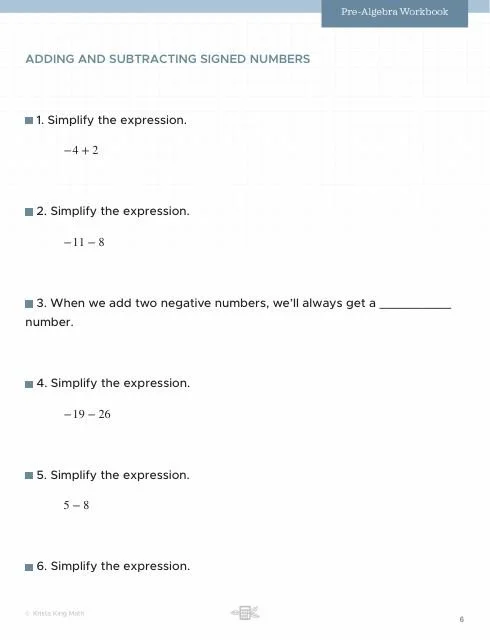
  • Adding and subtracting signed numbers
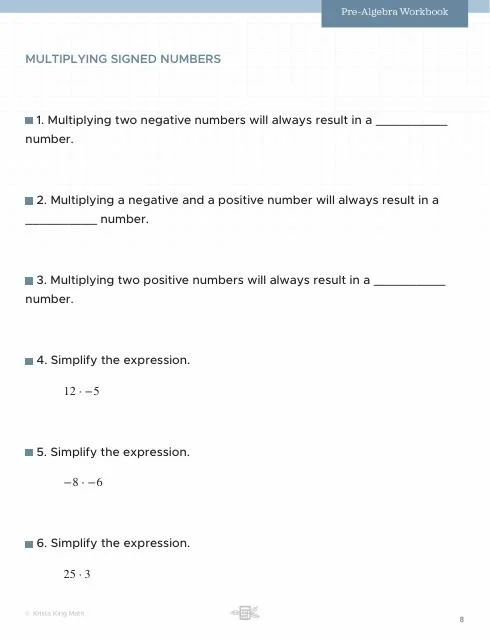
  • Multiplying signed numbers
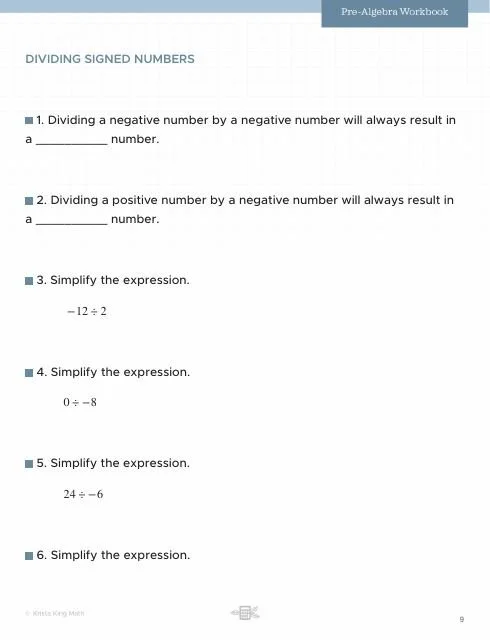
  • Dividing signed numbers
  • Absolute value of an expression
Factors and multiples
  • Divisibility
  • Multiples
  • Prime and composite
  • Prime factorization and product of primes
  • Least common multiple
  • Greatest common factor
Fractions
  • Fractions
  • Simplifying fractions and equivalent fractions
  • Division by zero
  • Adding and subtracting fractions
  • Multiplying and dividing fractions
  • Signs of fractions
  • Reciprocals
Mixed numbers
  • Mixed numbers and improper fractions
  • Adding and subtracting mixed numbers
  • Multiplying and dividing mixed numbers
  • Relationships of numbers
  • Adding mixed measures
Decimals
  • Place value
  • Decimal arithmetic
  • Repeating decimals
  • Rounding
Ratio and proportion
  • Ratio and proportion
  • Unit price
  • Unit multipliers
Exponents
  • Exponents
  • Rules of exponents
  • Power rule for exponents
  • Negative and other exponent rules
Radicals
  • Radicals
  • Adding and subtracting radicals
  • Multiplying radicals
  • Dividing radicals
  • Radical expressions
Scientific notation
  • Powers of 10
  • Scientific notation
  • Multiplying scientific notation
  • Dividing scientific notation
  • Multiplying and dividing scientific notation
  • Estimating scientific notation
Final exam
  • Practice exam 1
  • Practice exam 2
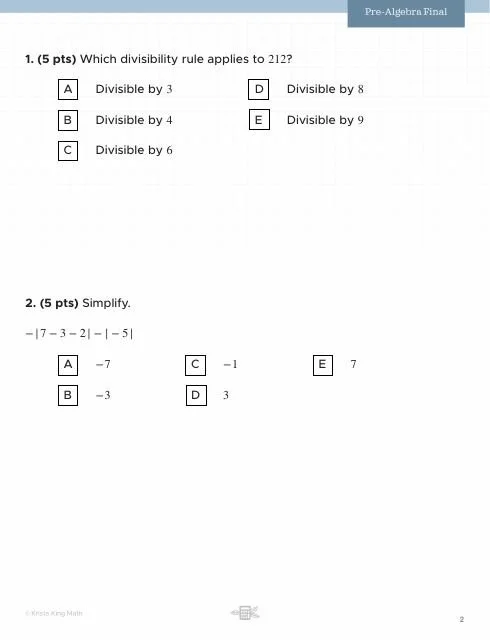
  • Pre-Algebra final exam

Course outline

Algebra 1

Operations
  • Variables
  • Identifying multiplication
  • Associative Property
  • Commutative Property
  • Transitive Property
  • Understood 1
  • Adding and subtracting like terms
  • Multiplying and dividing like terms
  • Distributive Property
  • Distributive Property with fractions
  • PEMDAS and order of operations
Equations
  • Evaluating expressions
  • Inverse operations
  • Simple equations
  • Balancing equations
  • Equations with subscripts
  • Word problems into equations
  • Consecutive integers
Polynomials
  • Adding and subtracting polynomials
  • Multiplying polynomials
  • Dividing polynomials
  • Multiplying multivariable polynomials
  • Dividing multivariable polynomials
Factoring
  • Greatest common factor
  • Quadratic polynomials
  • Difference of squares
  • Zero Theorem
  • Completing the square
  • Quadratic formula
Functions and graphing
  • Cartesian coordinate system
  • Slope
  • Point-slope and slope-intercept forms of a line
  • Graphing linear equations
  • Function notation
  • Domain and range
  • Testing for functions
  • Vertical Line Test
  • Sum of functions
  • Product of functions
  • Even, odd, or neither
  • Even, odd or neither
Inequalities
  • Trichotomy
  • Inequalities and negative numbers
  • Graphing inequalities on a number line
  • Graphing disjunctions on a number line
  • Graphing conjunctions on a number line
  • Graphing inequalities in the plane
  • Absolute value equations
  • Absolute value inequalities
Systems of equations
  • Two-step problems
  • Solving systems with substitution
  • Solving systems with elimination
  • Solving systems three ways
  • Systems of linear inequalities
Final exam
  • Practice exam 1
  • Practice exam 2
  • Algebra 1 final exam

Course outline

Geometry

Lines
  • Naming simple geometric figures
  • Parallel and perpendicular lines
  • Length of a line segment
  • Slope and midpoint of a line segment
  • Parallel and perpendicular line segments
  • Distance and midpoint in two and three dimensions
Angles
  • Measures of angles
  • Adjacent and nonadjacent angles
  • Complementary and supplementary angles
  • Vertical angles
  • Angle bisectors and trisectors
  • Angles and transversals
Triangles
  • Interior angles of triangles
  • Scalene, isosceles, and equilateral triangles
  • Acute, obtuse, and right triangles
  • Median, centroid, and altitude
  • Perpendicular and angle bisectors
  • SSS, ASA, and SAS congruence
  • AAS and HL congruence
  • Similar triangles
  • 45-45-90 triangles
  • 30-60-90 triangles
  • Triangle similarity theorems
  • Triangle Side-Splitting Theorem
  • Midsegments of triangles
  • Pythagorean Theorem
  • Pythagorean inequalities
  • Perimeter of a triangle
Quadrilaterals
  • Quadrilaterals
  • Trapezoids and kites
  • Parallelograms
  • Rhombuses, rectangles, and squares
  • Midsegments of trapezoids
  • Perimeter of a quadrilateral
Polygons
  • Convex and concave polygons
  • Interior angles of polygons
  • Exterior angles of polygons
  • Perimeter of a polygon
Circles
  • Equation of a circle
  • Special cases of the equation of a circle
  • General form of the equation of a circle
  • Degree measure of an arc
  • Circumference of a circle
  • Arc length
  • Inscribed angles of circles
  • Vertex on, inside, and outside the circle
  • Properties of arcs and chords
  • Intersecting chords
  • Tangent lines of circles
  • Intersecting tangents and secants
  • Circumscribed and inscribed circles of a triangle
Transformations
  • Translating figures in coordinate space
  • Rotating figures in coordinate space
  • Reflecting figures in coordinate space
  • Translation vectors
  • Dilations and scale factors
Area
  • Area of a triangle
  • Area of squares and rectangles
  • Area of a parallelogram
  • Area of a trapezoid
  • Area of rhombuses and kites
  • Area of a circle
  • Area of composite shapes
Surface area and volume
  • Nets, surface area, and volume of prisms
  • Surface area to volume ratio of prisms
  • Diagonal of a right rectangular prism
  • Nets, surface area, and volume of pyramids
  • Nets, surface area, and volume of cylinders
  • Nets, surface area, and volume of cones
  • Surface area and volume of spheres
Proofs and logic
  • Conditionals and Euler diagrams
  • Converses, inverses, and contrapositives
  • Arranging conditionals in a logical chain
  • Isosceles Triangle Theorem
  • CPCTC
  • Direct proofs
  • Indirect proofs
  • Paragraph proofs
  • Two-column proofs
  • Flowchart proofs
  • Coordinate proofs
Final exam
  • Practice exam 1
  • Practice exam 2
  • Geometry final exam

Course outline

Algebra 2

Exponents and radicals
  • Powers of negative bases
  • Powers of fractions
  • Zero as an exponent
  • Negative exponents
  • Negative exponents and product rule
  • Fractional exponents
  • Rationalizing the denominator
  • Rationalizing with conjugate method
Ratios and proportions
  • Ratios and proportions
  • Chemical compounds
  • Fractions to decimals to percents
  • Percent markup
  • Percent markdown
  • Calculating commission
  • Calculating simple interest
  • Complex fractions
  • Proportions with complex fractions
  • Imaginary and complex numbers
  • Rationalizing complex denominators
Factoring
  • Coefficients in quadratics
  • Grouping
  • Difference of cubes
  • Sum of cubes
Rational functions
  • Simplifying rational functions
  • Adding and subtracting rational functions
  • Factoring to find a common denominator
  • Multiplying rational functions
  • Dividing rational functions
Advanced equations
  • Direct variation
  • Inverse variation
  • Decimal equations
  • Fractional equations
  • Rational equations
  • Radical equations
  • Multivariable equations
  • Multivariable rational equations
Systems of equations
  • Systems with subscripts
  • Uniform motion problems
  • Number word problems
  • Age word problems
  • Systems with non-linear equations
  • Systems of three equations
Graphing
  • Parallel and perpendicular lines
  • Graphing parabolas
  • Center and radius of a circle
  • Graphing circles
  • Distance between two points
  • Equation modeling
  • Modeling a piecewise-defined function
  • Sketching graphs from story problems
  • Quadratic inequalities
  • Systems with quadratic inequalities
Manipulating functions
  • Combinations of functions
  • Composite functions
  • Domains of composite functions
  • Decomposing composite functions
  • One-to-one functions and the Horizontal Line Test
  • Inverse functions
  • Finding a function from its inverse
Exponential and logarithmic functions
  • What is a logarithm?
  • Common bases and restricted values
  • Evaluating logs
  • Laws of logarithms
  • Laws of natural logs
  • Solving logarithmic equations
  • Change of base
  • Graphing exponential functions
  • Graphing transformations of exponential functions
  • The general log rule
  • Graphing log functions
  • Graphing transformations of log functions
Final exam
  • Practice exam 1
  • Practice exam 2
  • Algebra 2 final exam

Course outline

Trigonometry

Angles
  • Naming angles
  • Complementary and supplementary angles
  • Positive and negative angles
  • Quadrant of the angle
  • Degrees, radians, and DMS
  • Coterminal angles
The six trig functions
  • Sine, cosine, and tangent
  • Cosecant, secant, cotangent, and the reciprocal identities
  • The quotient identities
  • The Pythagorean identities
  • Signs by quadrant
  • When the trig functions are undefined
The unit circle
  • The unit circle
  • Negative angles and angles more than one rotation
  • Coterminal angles in a particular interval
  • Reference angles
  • Symmetry across axes
  • Even-odd identities
  • The set of all possible angles
  • Points not on the unit circle
  • Solving right triangles
  • Angles of elevation and depression
Angles in circles
  • Radians and arc length
  • Area of a circular sector
  • Trig functions of real numbers
  • Linear and angular velocity
  • Relating linear and angular velocity
Graphing trig functions
  • Sketching sine and cosine
  • Sketching cosecant and secant
  • Period and amplitude
  • Sketching tangent and cotangent
  • Horizontal and vertical shifts
  • Graphing transformations
  • Graphing combinations
Inverse trig functions
  • Inverse trig relations
  • Inverse trig functions
  • Trig functions of inverse trig functions
Trig identities
  • Sum-difference identities for sine and cosine
  • Cofunction identities
  • Sum-difference identities for tangent
  • Double-angle identities
  • Half-angle identities
  • Product-to-sum identities
  • Sum-to-product identities
  • Proving the trig equation
  • Complete solution set of the equation
The law of sines and law of cosines
  • Law of sines
  • The ambiguous case of the law of sines
  • Area from the law of sines
  • Law of cosines
  • Heron's formula
Final exam
  • Practice exam 1
  • Practice exam 2
  • Trigonometry final exam

Course outline

Precalculus

Polar curves
  • Polar coordinates
  • Multiple ways to express polar points
  • Converting equations
  • Graphing polar curves in a rectangular system
  • Graphing circles
  • Graphing roses
  • Graphing cardioids
  • Graphing limaçons
  • Graphing lemniscates
  • Intersection of polar curves
Complex numbers
  • Complex numbers
  • Complex number operations
  • Graphing complex numbers
  • Distances and midpoints
  • Complex numbers in polar form
  • Multiplying and dividing polar forms
  • Powers of complex numbers and De Moivre's Theorem
  • Complex number equations
  • Roots of complex numbers
Matrices
  • Matrix dimensions and entries
  • Representing systems with matrices
  • Simple row operations
  • Gauss-Jordan elimination and reduced row-echelon form
  • Matrix addition and subtraction
  • Scalar multiplication and zero matrices
  • Matrix multiplication
  • Identity matrices
  • Transformations
  • Matrix inverses, and invertible and singular matrices
  • Solving systems with inverse matrices
  • Solving systems with Cramer's Rule
Partial fractions
  • Fraction decomposition
  • Distinct linear factors
  • Repeated linear factors
  • Distinct quadratic factors
  • Repeated quadratic factors
  • Mixed factors
Conic sections and analytic geometry
  • Identifying conic sections
  • Circles
  • Ellipses
  • Parabolas
  • Hyperbolas
  • Rotating axes
  • Polar equations of conics
Parametric curves
  • Parametric curves and eliminating the parameter
  • Direction of the parameter
  • Finding the parametric representation
Final exam
  • Practice exam 1
  • Practice exam 2
  • Precalculus final exam

Course outline

Probability & Statistics

Visualizing data
  • One-way tables
  • Bar graphs and pie charts
  • Line graphs and ogives
  • Two-way tables
  • Venn diagrams
  • Frequency tables and dot plots
  • Relative frequency tables
  • Joint distributions
  • Histograms and stem-and-leaf plots
  • Building histograms from data sets
Analyzing data
  • Measures of central tendency
  • Measures of spread
  • Changing the data, and outliers
  • Box-and-whisker plots
Data distributions
  • Mean, variance, and standard deviation
  • Frequency histograms and polygons, and density curves
  • Symmetric and skewed distributions and outliers
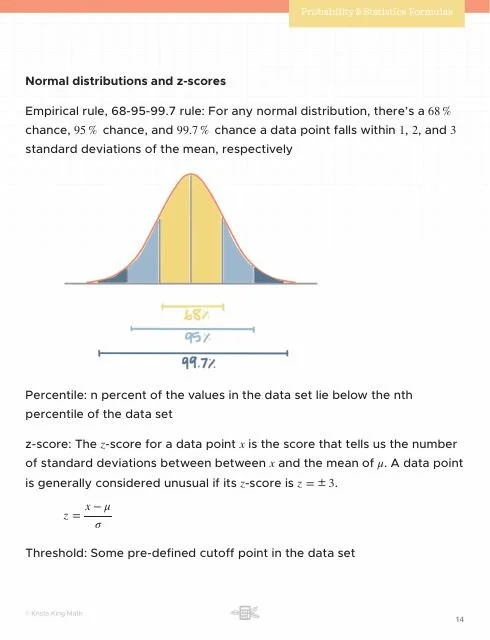
  • Normal distributions and z-scores
  • Chebyshev's Theorem
  • Covariance
  • Correlation coefficient
  • Weighted means and grouped data
Probability
  • Simple probability
  • The addition rule, and union vs. intersection
  • Independent and dependent events and conditional probability
  • Bayes' Theorem
Discrete random variables
  • Discrete probability
  • Transforming random variables
  • Combinations of random variables
  • Permutations and combinations
  • Binomial random variables
  • Poisson distributions
  • "At least" and "at most," and mean, variance, and standard deviation
  • Bernoulli random variables
  • Geometric random variables
Sampling
  • Types of studies
  • Sampling and bias
  • Sampling distribution of the sample mean
  • Conditions for inference with the SDSM
  • Sampling distribution of the sample proportion
  • Conditions for inference with the SDSP
  • The student's t-distribution
  • Confidence interval for the mean
  • Confidence interval for the proportion
Hypothesis testing
  • Inferential statistics and hypotheses
  • Significance level and type I and II errors
  • Test statistics for one- and two-tailed tests
  • The p-value and rejecting the null
  • Hypothesis testing for the population proportion
  • Confidence interval for the difference of means
  • Hypothesis testing for the difference of means
  • Matched-pair hypothesis testing
  • Confidence interval for the difference of proportions
  • Hypothesis testing for the difference of proportions
Regression
  • Scatterplots and regression
  • Correlation coefficient and the residual
  • Coefficient of determination and RMSE
  • Chi-square tests
Final exam
  • Practice exam 1
  • Practice exam 2
  • Probability & Statistics final exam

Course outline

Calculus 1

Definition of the limit
  • Idea of the limit
  • One-sided limits
  • Proving that the limit does not exist
  • Precise definition of the limit
Combinations and composites
  • Limits of combinations
  • Limits of composites
Continuity
  • Point discontinuities
  • Jump discontinuities
  • Infinite discontinuities
  • Endpoint discontinuities
Intermediate Value Theorem
  • Intermediate Value Theorem with an interval
  • Intermediate Value Theorem without an interval
Solving limits
  • Solving with substitution
  • Solving with factoring
  • Solving with conjugate method
  • Infinite limits and vertical asymptotes
  • Limits at infinity and horizontal asymptotes
  • Crazy graphs
  • Trigonometric limits
  • Making the function continuous
Squeeze Theorem
  • Squeeze Theorem
Definition of the derivative
  • Definition of the derivative
Derivative rules
  • Power rule
  • Power rule for negative powers
  • Power rule for fractional powers
  • Product rule with two functions
  • Product rule with three or more functions
  • Quotient rule
  • Trigonometric derivatives
  • Exponential derivatives
  • Logarithmic derivatives
Chain rule
  • With power rule
  • With trig, log, and exponential functions
  • With product rule
  • With quotient rule
Other derivatives
  • Inverse trigonometric derivatives
  • Hyperbolic derivatives
  • Inverse hyperbolic derivatives
  • Logarithmic differentiation
Tangent and normal lines
  • Tangent lines
  • Value that makes two tangent lines parallel
  • Values that make the function differentiable
  • Normal lines
  • Average rate of change
Implicit differentiation
  • Implicit differentiation
  • Equation of the tangent line with implicit differentiation
  • Higher-order derivatives
  • Second derivatives with implicit differentiation
Optimization and sketching graphs
  • Critical points and the first derivative test
  • Inflection points and the second derivative test
  • Intercepts and vertical asymptotes
  • Horizontal and slant asymptotes
  • Sketching graphs
  • Extrema on a closed interval
  • Sketching f(x) from f'(x)
Linear approximation
  • Linear approximation
  • Estimating a root
  • Absolute, relative, and percentage error
Related rates
  • Radius of the balloon
  • Price of the product
  • Water level in the tank
  • Observer and the airplane
  • Ladder sliding down the wall
Applied optimization
  • Applied optimization
Derivative theorems
  • Mean Value Theorem
  • Rolle's Theorem
  • Newton's Method
  • L'Hospital's Rule
Physics and economics
  • Position, velocity, and acceleration
  • Ball thrown up from the ground
  • Coin dropped from the roof
  • Marginal cost, revenue, and profit
Exponential growth and decay
  • Half-life
  • Newton's Law of Cooling
  • Sales decline
  • Compounding interest
Final exam
  • Practice exam 1
  • Practice exam 2
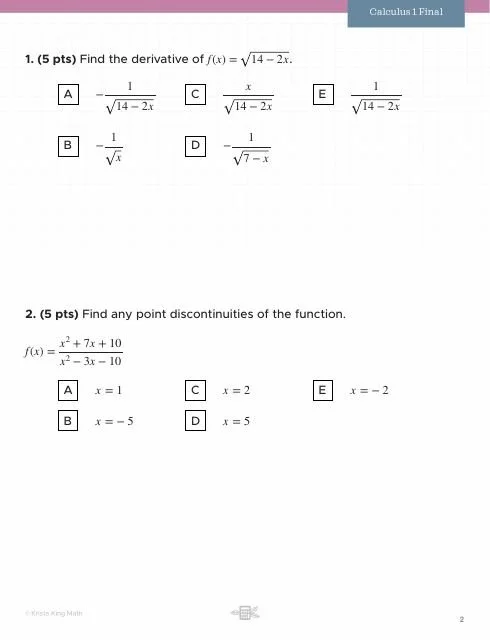
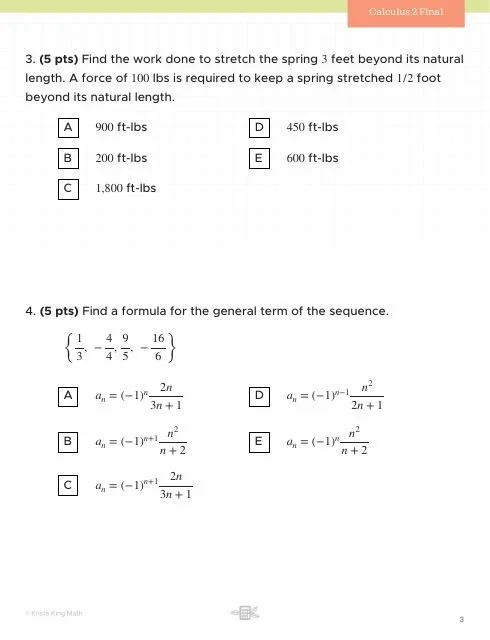
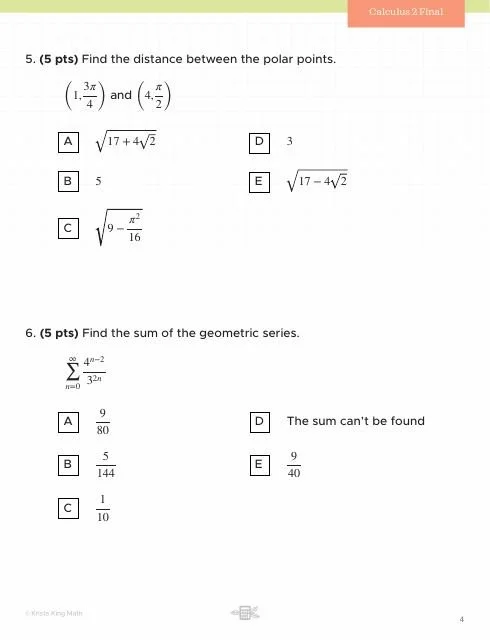
  • Calculus 1 final exam

Course outline

Calculus 2

Indefinite integrals
  • Indefinite integrals
  • Computing indefinite integrals
  • Trigonometric integrals
  • Initial value problems
  • Find f given f'' or f'''
Definite integrals
  • Summation notation
  • Riemann sums
  • Over and underestimation
  • Converting summation notation to the integral
  • Definite integrals
  • Properties of integrals
  • Integrating even and odd functions
  • Part 1 of the Fundamental Theorem of Calculus
  • Part 2 of the Fundamental Theorem of Calculus
  • Integrating piecewise functions
  • Area under or enclosed by the curve
  • Net Change Theorem
Approximating area
  • Limit process to find area
  • Midpoint Rule
  • Trapezoidal Rule
  • Simpson's Rule
  • Error bounds
Substitution and integration by parts
  • Substitution
  • Substitution in definite integrals
  • Integration by parts
  • Integration by parts with substitution
  • Integration by parts two and three times
  • Tabular integration
Trigonometric integrals
  • Integrating sin^m cos^n
  • Integrating tan^m sec^n
  • Integrating products of single sine and cosine factors
  • Hyperbolic integrals
  • Inverse hyperbolic integrals
Trigonometric substitution
  • Trigonometric substitution setup
  • Trigonometric substitution with secant
  • Trigonometric substitution with sine
  • Trigonometric substitution with tangent
Reduction formulas
  • Integrals using tables
Partial fractions
  • Distinct linear factors
  • Repeated linear factors
  • Distinct and repeated quadratic factors
  • Rationalizing substitutions
Improper integrals
  • Improper integrals, cases 1-3
  • Improper integrals, cases 4-6
  • Comparison Theorem
Area between curves
  • Upper and lower curves
  • Left and right curves
  • More than one intersection
  • Sketching the region
  • Dividing a region into equal parts
Average value
  • Average value
  • Mean Value Theorem for integrals
Arc length and surface area of revolution
  • Arc length of a curve y=f(x)
  • Arc length of a curve x=g(y)
  • Surface area of revolution about the x-axis
  • Surface area of revolution about the y-axis
Volume of revolution and volume by cross sections
  • Disks around the x- or y-axis
  • Disks around other axes
  • Washers around the x- or y-axis
  • Washers around other axes
  • Cylindrical shells
  • Cross sections: squares and rectangles
  • Cross sections: triangles and semicircles
Work
  • Work to lift a mass or weight
  • Work on elastic springs with Hooke's Law
  • Work to empty a tank
  • Work by a variable force
Moments, center of mass, and centroids
  • Moments and center of mass
  • Centroids of plane regions
  • Area of a triangle with given vertices
  • Theorem of Pappus
Physics
  • Hydrostatic force
  • Vertical motion
  • Rectilinear motion: displacement and distance
Economics
  • Present and future value
  • Compound interest: n times per year and continuously
  • Income streams
  • Consumer and producer surplus
Probability
  • Probability density functions
  • Mean and expected value
  • Median
Biology
  • Cardiac output
  • Poiseuille's Law
  • Poiseuille’s Law
Differential equations
  • Modeling: order and solutions
  • Verifying a solution to a differential equation
  • Direction fields
  • Euler's method
  • Separable equations: general and particular solutions
  • Exponential growth and decay models
  • The logistic model
  • Linear equations and integrating factors
Parametric curves
  • Eliminating the parameter
  • Derivative of a parametric curve
  • Second derivative of a parametric curve
  • Sketching parametric curves by plotting points
Calculus with parametric curves
  • Tangent line to the parametric curve
  • Area under a parametric curve
  • Area under one arc or loop of a parametric curve
  • Arc length of a parametric curve
  • Surface area of revolution of a parametric curve, horizontal axis
  • Surface area of revolution of a parametric curve, vertical axis
  • Volume of revolution with parametric curves
Polar curves
  • Converting to polar coordinates
  • Converting rectangular equations
  • Converting polar equations
  • Distance between polar points
  • Sketching polar curves
Calculus with polar curves
  • Tangent line to the polar curve
  • Vertical and horizontal tangent lines to the polar curve
  • Intersection of polar curves
  • Area inside a polar curve
  • Area bounded by one loop of a polar curve
  • Area between polar curves
  • Area inside both polar curves
  • Arc length of a polar curve
  • Surface area of revolution of a polar curve
Sequences
  • Sequences vs. series
  • Finding the terms of a sequence
  • Formula for the general term
  • Convergence and the limit of a sequence
  • Monotonic and bounded sequences
Partial sums and series sums
  • Partial sums
  • Sum of a series from its partial sums
  • Convergence and sum of a telescoping series
Geometric series
  • Geometric series test
  • Sum of a geometric series
  • Values for which a geometric series converges
  • Repeating decimals
Integral test and p-series
  • Recognizing types of series
  • nth term test for divergence
  • Integral test
  • Harmonic series and p-series
Comparison tests
  • Comparison test
  • Limit comparison test
  • Remainder estimate for a convergent series
Alternating series
  • Alternating series test
  • Alternating series estimation theorem
Ratio and root tests
  • Ratio test
  • Ratio test with factorials
  • Root test
  • Absolute and conditional convergence
Power series
  • Power series and their representations
  • Radius and interval of convergence
  • Differentiation and integration of power series
  • Multiplication and division of power series
  • Binomial series
  • Estimating integrals with power series
Taylor and Maclaurin series
  • Taylor series
  • Maclaurin series centered at zero
  • Taylor polynomial approximations
  • Taylor's inequality and the Lagrange error bound
  • Radius and interval of convergence
  • Representing and estimating integrals as series
  • Evaluating limits with series
Final exam
  • Practice exam 1
  • Practice exam 2
  • Calculus 2 final exam

Course outline

Calculus 3

Three-dimensional coordinate systems
  • Plotting points in three dimensions
  • Distance between points in three dimensions
  • Center, radius, and equation of the sphere
  • Describing a region in three-dimensional space
  • Using inequalities to describe the region
Sketching graphs and level curves
  • Sketching level curves of multivariable functions
Lines and planes
  • Vector and parametric equations of a line
  • Parametric and symmetric equations of a line
  • Symmetric equations of a line
  • Parallel, intersecting, skew, and perpendicular lines
  • Equation of a plane
  • Intersection of a line and a plane
  • Parallel, perpendicular and angle between planes
  • Parametric equations for the line of intersection of two planes
  • Symmetric equations for the line of intersection of two planes
  • Distance between a point and a line
  • Distance between a point and a plane
  • Distance between parallel planes
Cylinders and quadric surfaces
  • Reference chart for quadric surfaces
  • Reducing equations to standard form
  • Sketching the surface
  • Traces to sketch and identify the surface
Limits and continuity
  • Domain of a multivariable function
  • Limit of a multivariable function
  • Precise definition of the limit for multivariable functions
  • Discontinuities of multivariable functions
  • Compositions of multivariable functions
Partial derivatives
  • Partial derivatives in two variables
  • Partial derivatives in three or more variables
  • Higher order partial derivatives
Differentials
  • Differential of a multivariable function
Chain rule
  • Chain rule for multivariable functions
  • Chain rule for multivariable functions and tree diagrams
Implicit differentiation
  • Implicit differentiation for multivariable functions
Directional derivatives
  • Directional derivatives in the direction of the vector
  • Directional derivatives in the direction of the angle
Linear approximation and linearization
  • Linear approximation in two variables
  • Linearization of a multivariable function
Gradient vectors
  • Gradient vectors
  • Gradient vectors and the tangent plane
  • Maximum rate of change and its direction
Tangent planes and normal lines
  • Equation of the tangent plane
  • Normal line to the surface
Optimization
  • Critical points
  • Second derivative test
  • Local extrema and saddle points
  • Global extrema
  • Extreme value theorem
Applied optimization
  • Maximum product of three real numbers
  • Maximum volume of a rectangular box inscribed in a sphere
  • Minimum distance from the point to the plane
  • Points on the cone closest to the given point
  • Applied optimization
Lagrange multipliers
  • Lagrange multipliers
  • Two dimensions, one constraint
  • Three dimensions, one constraint
  • Three dimensions, two constraints
Approximating double integrals
  • Approximating double integrals with rectangles
  • Midpoint rule for double integrals
  • Riemann sums for double integrals
Double integrals
  • Average value
  • Double and iterated integrals
  • Iterated integrals
  • Double integrals
  • Type I and II regions
  • Finding surface area
  • Finding volume
  • Changing the order of integration
Double integrals in polar coordinates
  • Changing iterated integrals to polar coordinates
  • Changing double integrals to polar coordinates
  • Sketching area
  • Finding area
  • Finding volume
Applications of double integrals
  • Double integrals to find mass and center of mass
Approximating triple integrals
  • Midpoint rule for triple integrals
Triple integrals
  • Iterated and triple integrals
  • Iterated integrals
  • Triple integrals
  • Average value
  • Finding volume
  • Expressing the integral six ways
  • Type I, II, and III regions
Triple integrals in cylindrical coordinates
  • Cylindrical coordinates
  • Changing triple integrals to cylindrical coordinates
  • Finding volume
Triple integrals in spherical coordinates
  • Spherical coordinates
  • Changing triple integrals to spherical coordinates
  • Finding volume
Change of variables
  • Jacobian for two variables
  • Jacobian for three variables
  • Evaluating double integrals
  • Equations of the transformation
  • Image of the set under the transformation
Applications of triple integrals
  • Triple integrals to find mass and center of mass
  • Moments of inertia
Introduction to vectors
  • Vector from two points
  • Combinations of vectors
  • Sum of two vectors
  • Copying vectors and using them to find combinations
  • Unit vector in the direction of the given vector
  • Angle between a vector and the x-axis
  • Magnitude and angle of the resultant force
Dot products
  • Dot product of two vectors
  • Angle between two vectors
  • Orthogonal, parallel, or neither
  • Acute angle between the lines
  • Acute angle between the curves
  • Acute angles between the curves
  • Direction cosines and direction angles
  • Scalar equation of a line
  • Scalar equation of a plane
  • Scalar and vector projections
Cross products
  • Cross product of two vectors
  • Vector orthogonal to the plane
  • Volume of the parallelepiped from vectors
  • Volume of the parallelepiped from adjacent edges
  • Scalar triple product to prove vectors are coplanar
Vector functions and space curves
  • Domain of a vector function
  • Limit of a vector function
  • Sketching the vector equation
  • Projections of the curve
  • Vector and parametric equations of a line segment
  • Vector function for the curve of intersection of two surfaces
Derivatives and integrals of vector functions
  • Derivative of a vector function
  • Unit tangent vector
  • Parametric equations of the tangent line
  • Integral of a vector function
Arc length and curvature
  • Arc length of a vector function
  • Reparametrizing the curve
  • Unit tangent and unit normal vectors
  • Curvature
  • Maximum curvature
  • Normal and osculating planes
Velocity and acceleration
  • Velocity and acceleration vectors
  • Velocity, acceleration and speed, given position
  • Velocity and position given acceleration and initial conditions
  • Tangential and normal components of acceleration
Line integrals
  • Line integral
  • Line integral of a curve
  • Line integral of a vector function
  • Potential function of a conservative vector field
  • Potential function of a conservative vector field to evaluate a line integral
  • Independence of path
  • Work done by the force field
  • Open, connected, and simply-connected
Green's Theorem
  • Green's Theorem for one region
  • Green's Theorem for two regions
Curl and divergence
  • Curl and divergence of a vector field
  • Potential function of a conservative vector field, three dimensions
Parametric surfaces and areas
  • Points on the surface
  • Surface of the vector equation
  • Parametric representation of the surface
  • Tangent plane to the parametric surface
  • Area of a surface
Surface integrals
  • Surface integrals
Stokes' and divergence theorem
  • Stokes' theorem
  • Divergence theorem
  • Divergence theorem for surface integrals
  • Divergence theorem and flux
Final exam
  • Practice exam 1
  • Practice exam 2
  • Calculus 3 final exam

Course outline

Differential Equations

First order equations
  • Classifying differential equations
  • Linear equations
  • Initial value problems
  • Separable equations
  • Substitutions
  • Bernoulli equations
  • Homogeneous equations
  • Exact equations
Second order equations
  • Second order linear homogeneous equations
  • Reduction of order
  • Undetermined coefficients for nonhomogeneous equations
  • Variation of parameters for nonhomogeneous equations
  • Fundamental solution sets and the Wronskian
  • Variation of parameters with the Wronskian
  • Initial value problems with nonhomogeneous equations
Modeling with differential equations
  • Direction fields and solution curves
  • Intervals of validity
  • Euler's method
  • Autonomous equations and equilibrium solutions
  • The logistic equation
  • Predator-prey systems
  • Exponential growth and decay
  • Mixing problems
  • Newton's Law of Cooling
  • Electrical series circuits
  • Spring and mass systems
Series solutions
  • Power series basics
  • Adding power series
  • Power series solutions
  • Nonpolynomial coefficients
  • Singular points and Frobenius' Theorem
Laplace transforms
  • The Laplace transform
  • Table of transforms
  • Exponential type
  • Partial fractions decompositions
  • Inverse Laplace transforms
  • Transforming derivatives
  • Laplace transforms for initial value problems
  • Step functions
  • Second Shifting Theorem
  • Laplace transforms of step functions
  • Step functions with initial value problems
  • The Dirac delta function
  • Convolution integrals
  • Convolution integrals for initial value problems
Systems of differential equations
  • Matrix basics
  • Building systems
  • Solving systems
  • Distinct real Eigenvalues
  • Equal real Eigenvalues with multiplicity two
  • Equal real Eigenvalues with multiplicity three
  • Complex Eigenvalues
  • Phase portraits for distinct real Eigenvalues
  • Phase portraits for equal real Eigenvalues
  • Phase portraits for complex Eigenvalues
  • Undetermined coefficients for nonhomogeneous systems
  • Variation of parameters for nonhomogeneous systems
  • The matrix exponential
Higher order equations
  • Homogeneous higher order equations
  • Undetermined coefficients for higher order equations
  • Variation of parameters for higher order equations
  • Laplace transforms for higher order equations
  • Systems of higher order equations
  • Series solutions of higher order equations
Fourier series
  • Fourier series representations
  • Periodic functions and periodic extensions
  • Representing piecewise functions
  • Convergence of a Fourier series
  • Fourier cosine series
  • Fourier sine series
  • Cosine and sine series of piecewise functions
Partial differential equations
  • Separation of variables
  • Boundary value problems
  • The heat equation
  • Changing the temperature boundaries
  • Laplace's equation
Final exam
  • Practice exam 1
  • Practice exam 2
  • Differential Equations final exam

Course outline

Linear Algebra

Operations on one matrix
  • Linear systems in two unknowns
  • Linear systems in three unknowns
  • Matrix dimensions and entries
  • Representing systems with matrices
  • Simple row operations
  • Pivot entries and row-echelon forms
  • Gauss-Jordan elimination
  • Number of solutions to the linear system
Operations on two matrices
  • Matrix addition and subtraction
  • Scalar multiplication
  • Zero matrices
  • Matrix multiplication
  • Identity matrices
  • The elimination matrix
Matrices as vectors
  • Vectors
  • Vector operations
  • Unit vectors and basis vectors
  • Linear combinations and span
  • Linear independence in two dimensions
  • Linear independence in three dimensions
  • Linear subspaces
  • Spans as subspaces
  • Basis
Dot products and cross products
  • Dot products
  • Cauchy-Schwarz inequality
  • Vector triangle inequality
  • Angle between vectors
  • Equation of a plane, and normal vectors
  • Cross products
  • Dot and cross products as opposite ideas
Matrix-vector products
  • Multiplying matrices by vectors
  • The null space and Ax=O
  • Null space of a matrix
  • The column space and Ax=b
  • Solving Ax=b
  • Dimensionality, nullity, and rank
Transformations
  • Functions and transformations
  • Transformation matrices and the image of the subset
  • Preimage, image, and the kernel
  • Linear transformations as matrix-vector products
  • Linear transformations as rotations
  • Adding and scaling linear transformations
  • Projections as linear transformations
  • Compositions of linear transformations
Inverses
  • Inverse of a transformation
  • Invertibility from the matrix-vector product
  • Inverse transformations are linear
  • Matrix inverses, and invertible and singular matrices
  • Solving systems with inverse matrices
Determinants
  • Determinants
  • Cramer's rule for solving systems
  • Modifying determinants
  • Upper and lower triangular matrices
  • Using determinants to find area
Transposes
  • Transposes and their determinants
  • Transposes of products, sums, and inverses
  • Null and column spaces of the transpose
  • The product of a matrix and its transpose
  • A=LU factorization
Orthogonality and change of basis
  • Orthogonal complements
  • Orthogonal complements of the fundamental subspaces
  • Projection onto the subspace
  • Least squares solution
  • Coordinates in a new basis
  • Transformation matrix for a basis
Orthonormal bases and Gram-Schmidt
  • Orthonormal bases
  • Projection onto an orthonormal basis
  • Gram-Schmidt process for change of basis
Eigenvalues and Eigenvectors
  • Eigenvalues, eigenvectors, eigenspaces
  • Eigen in three dimensions
Final exam
  • Practice exam 1
  • Practice exam 2
  • Linear Algebra final exam